Kabbalistic Tarot & the Four Worlds
Frater Lucis · 13 January 2026
Beyond the Traditional Elements
Ask any tarot reader what the suits mean and you'll get the standard answer: Wands are Fire, Cups are Water, Swords are Air, Pentacles are Earth. This elemental correspondence is useful—it's not wrong—but it's incomplete. It tells you what each suit represents without explaining why or showing you the deeper cosmological structure that gives these associations their power.
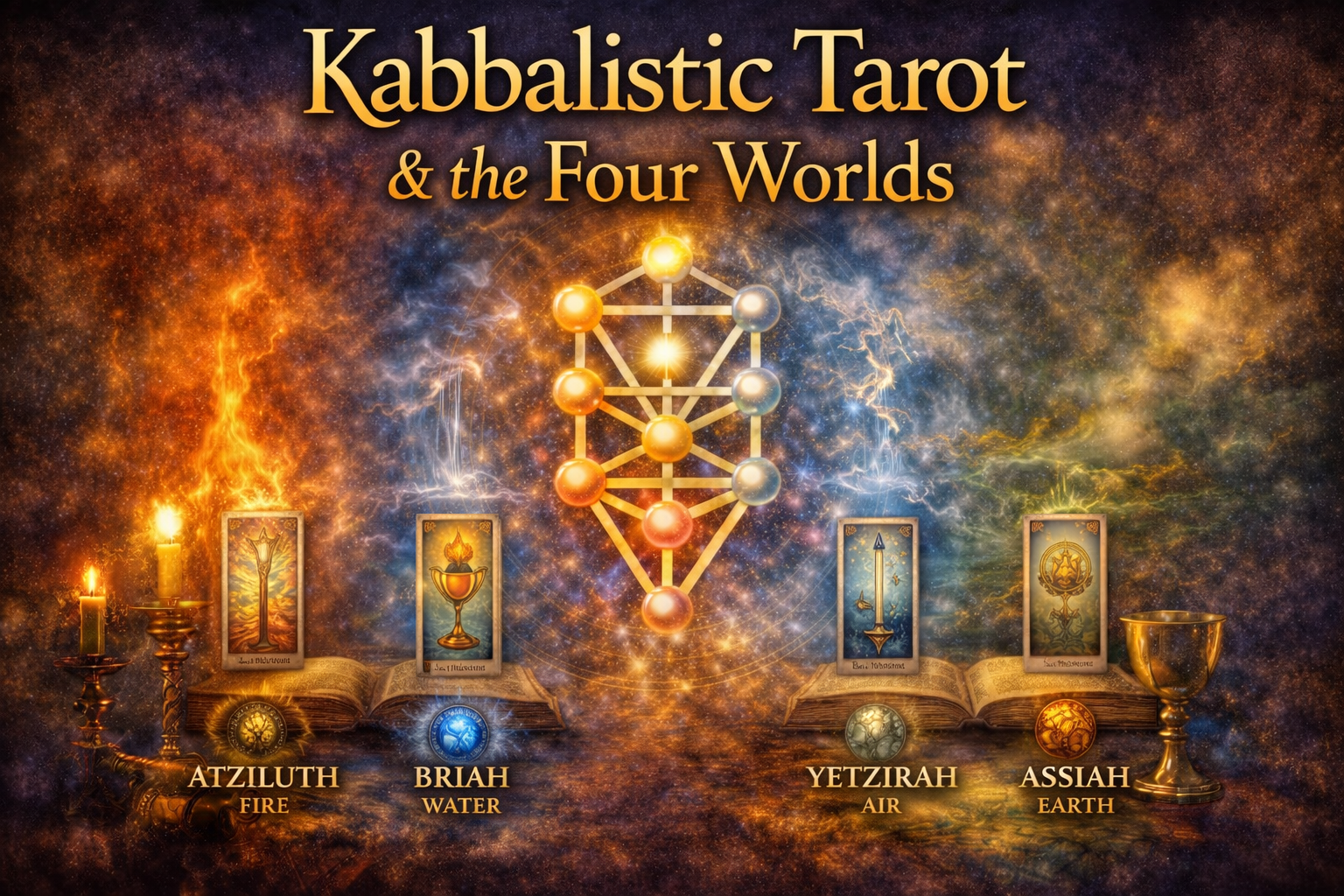
In Kabbalah, reality isn't just divided into four elements. It's structured into Four Worlds (or Olamot in Hebrew)—four distinct levels of existence that describe how divine energy descends from pure spirit into dense matter. Everything that exists participates in all Four Worlds simultaneously. Your body exists in one world, your emotions in another, your thoughts in a third, and your deepest spiritual essence in a fourth.
The Minor Arcana—those 56 cards of Wands, Cups, Swords, and Pentacles—aren't just elemental symbols. They're a map of these Four Worlds, showing you how divine consciousness manifests at different frequencies of reality.
The Four Worlds of Kabbalah:
Atziluth - The World of Emanation (Divine/Archetypal) → Wands/Fire
Briah - The World of Creation (Soul/Formative) → Cups/Water
Yetzirah - The World of Formation (Mental/Astral) → Swords/Air
Assiah - The World of Action (Physical/Material) → Pentacles/Earth
Each world contains its own complete Tree of Life. In other words, the ten Sephiroth we discussed in Part 1 exist at all four levels—Kether in Atziluth is pure divine will, Kether in Assiah is the crown of physical existence, and so on. This is why each suit has cards numbered Ace through Ten—each number corresponds to a Sephirah expressing itself through that particular world.
Let me break down each world so you can see how this transforms your understanding of the suits.
Atziluth: The World of Emanation (Wands/Fire)
Atziluth is the highest world, the realm of pure divine will before it takes any form whatsoever. This is raw creative fire, unfiltered archetypal energy. When you're in Atziluth consciousness, you're experiencing the direct impulse from Source—inspiration, vision, the "download" that comes before you have words for it.
Wands represent Atziluth because fire is the element of pure spirit, transformation, and initiation. When Wand cards appear in a reading, they're showing you where divine creative force is trying to move through the querent's life. This isn't about practical plans or emotional processing—it's about the spark, the calling, the raw yes that precedes all manifestation.
Traditional interpretation: "Wands mean action, passion, creativity."
Kabbalistic understanding: "Wands show divine will seeking expression through spiritual fire."
Why this matters in readings:
When someone pulls the Ace of Wands, you're not just seeing "a new creative project." You're witnessing the moment when Kether—pure potential—erupts into Atziluth, the world of divine emanation. This is a spiritual initiation, a calling that demands they align with something greater than their personal desires.
When they pull the Five of Wands, you're not just seeing "conflict and competition." You're seeing Geburah (severity, the fifth Sephirah) expressing through spiritual fire—the necessary destruction of false visions, the battle that tests whether their inspiration is real or just ego inflation.
The Court Cards in Atziluth represent spiritual archetypes:
King of Wands: The fully realized creative will, the spiritual master
Queen of Wands: The sovereign who channels divine inspiration with confidence
Knight of Wands: The spiritual warrior, the initiate in motion
Page of Wands: The first spark of calling, the messenger of divine vision
Briah: The World of Creation (Cups/Water)
Briah is the second world, where pure divine will begins to take shape through the soul's emotional intelligence. This is the realm of relationships, feelings, the heart's knowing. Atziluth is the spark; Briah is the vessel that holds and shapes it through love, longing, grief, joy.
Cups represent Briah because water is the element of the soul, flowing and adaptive, capable of holding whatever form is poured into it. When Cup cards appear, they're revealing the emotional truth beneath the surface, the soul-level patterns that drive behavior.
Traditional interpretation: "Cups mean emotions, relationships, intuition."
Kabbalistic understanding: "Cups show soul-level patterns expressing through the emotional body."
Why this matters in readings:
The Ace of Cups isn't just "new love" or "emotional beginning." It's Kether descending into Briah—the moment when divine love becomes a felt experience in the soul. This is grace, the gift of being seen and held by something greater.
The Three of Cups isn't just "celebration with friends." It's Binah (understanding, the stabilizing force) expressing through emotional reality. Three cups—three people—forming a stable container for joy. This is soul-level community, not just socializing. The card reveals why some celebrations feel empty and others feel sacred: it depends on whether Binah's stabilizing presence is there.
The Court Cards in Briah represent emotional intelligence:
King of Cups: Mastery of the emotional realm without being ruled by it
Queen of Cups: The one who feels everything and transmutes it into compassion
Knight of Cups: The romantic, the dreamer pursuing soul-level connection
Page of Cups: The first stirring of emotional awareness, the inner child awakening
Yetzirah: The World of Formation (Swords/Air)
Yetzirah is the third world, the realm of mental constructs, thought forms, and the astral plane where ideas begin to crystallize into structures. This is where the divine will (Atziluth) that's been held by the soul (Briah) gets translated into concepts, plans, narratives, beliefs.
Swords represent Yetzirah because air is the element of intellect, communication, the cutting edge of discrimination that separates truth from illusion. When Sword cards appear, they're showing you the mental landscape—what stories the querent is telling themselves, what thoughts are cutting them off from deeper knowing.
Traditional interpretation: "Swords mean conflict, challenges, mental clarity."
Kabbalistic understanding: "Swords show the mind's attempt to give form to what the soul already knows."
Why this matters in readings:
Swords get a bad reputation in tarot because they're often "negative" cards—pain, loss, betrayal, anxiety. But in the Kabbalistic framework, you understand why: Yetzirah is where we get trapped in mental constructs that separate us from direct experience. The mind creates stories, and those stories can imprison us or liberate us.
The Ace of Swords isn't just "mental clarity" or "breakthrough." It's Kether piercing through Yetzirah—the moment when thought aligns with truth, when the mind stops spinning and knows. This is revelation, the "aha" that cuts through confusion.
The Three of Swords isn't just "heartbreak." It's Binah (understanding) expressing through the mental realm—the moment when the mind finally grasps what the heart already knew, and the grief is the integration of that knowing. Three swords piercing a heart: understanding is painful when it forces you to see what you were avoiding.
The Court Cards in Yetzirah represent intellectual mastery:
King of Swords: The judge, the one who discerns truth from illusion
Queen of Swords: The clear communicator who speaks difficult truths with precision
Knight of Swords: The crusader for ideas, charging ahead with mental certainty
Page of Swords: The curious mind, the student learning to think clearly
Assiah: The World of Action (Pentacles/Earth)
Assiah is the fourth and final world, the physical realm where everything we've traced—divine will, soul patterns, mental constructs—finally lands in material form. This is the world your body lives in, where consequences are tangible, where money flows or doesn't, where structures either stand or crumble.
Pentacles represent Assiah because earth is the element of manifestation, the concrete result of all that came before. When Pentacle cards appear, they're showing you what has actually materialized in physical reality, the fruits of all those other levels.
Traditional interpretation: "Pentacles mean money, material success, practical matters."
Kabbalistic understanding: "Pentacles show divine will fully manifested into physical form."
Why this matters in readings:
Pentacles aren't separate from spirit—they're the completion of spirit's descent into matter. A reading full of Pentacles isn't "less spiritual" than one full of Cups or Wands. It's showing you where the divine has successfully landed in the material plane.
The Ace of Pentacles isn't just "financial opportunity." It's Kether manifesting in Assiah—the seed of divine abundance taking physical form. This is the moment when vision becomes tangible, when the abstract becomes concrete. A job offer, a seed in soil, a foundation stone laid.
The Ten of Pentacles isn't just "wealth and legacy." It's Malkuth (kingdom, the tenth Sephirah) fully realized in the material world—the completion of a cycle where spiritual intention has created lasting physical structures. Family wealth, ancestral land, institutions that endure. This is spirit made permanent in matter.
The Court Cards in Assiah represent practical wisdom:
King of Pentacles: The master of physical resources, the builder of lasting wealth
Queen of Pentacles: The nurturer who creates material abundance through care
Knight of Pentacles: The steady worker, methodically manifesting goals
Page of Pentacles: The apprentice learning practical skills, the first paycheck
Reading with the Four Worlds
Now here's where this framework becomes powerful in practice. When you pull cards across multiple suits, you're not just seeing "different areas of life"—you're seeing how energy is moving (or blocked) between different levels of reality.
Example reading: Three of Cups + Five of Swords + Ace of Pentacles
Traditional interpretation might say: "Celebration with friends, followed by conflict, but new financial opportunity arrives."
Kabbalistic reading reveals the pattern:
Three of Cups (Binah in Briah): There's a stable emotional foundation, soul-level connection, genuine community
Five of Swords (Geburah in Yetzirah): But when that tries to move into the mental realm, conflict erupts—the mind creates stories about who won, who lost, who was betrayed
Ace of Pentacles (Kether in Assiah): Despite the mental conflict, divine abundance is trying to manifest physically
The insight: The querent has real emotional support (Briah), but their thoughts about that support (Yetzirah) are creating unnecessary conflict. If they can bypass the mental drama and stay rooted in the soul-level truth, material abundance (Assiah) will flow naturally.
See how much more specific that is? You're not just describing separate events—you're diagnosing where energy is flowing smoothly and where it's getting distorted as it descends through the worlds.
Why Modern Tarot Lost This
When tarot entered mainstream culture, the Four Worlds framework was too esoteric, too complex for casual users. So it got simplified to "Fire = passion, Water = emotions, Air = thoughts, Earth = material." That works as a starting point, but it strips away the cosmological architecture.
You can read tarot your whole life with just elemental correspondences and get decent results. But you'll hit a ceiling. You'll have readings where the cards seem contradictory, where your intuition can't quite bridge the gaps, where you know something deeper is there but you can't name it.
The Four Worlds gives you that missing layer. It shows you why the Ace of Wands feels fundamentally different from the Ace of Pentacles—not just because one is "spiritual" and one is "material," but because they represent the same divine emanation (Kether) expressing at completely different frequencies of reality. And once you understand the Four Worlds, we can go even deeper. Each numbered card—Ace through Ten—corresponds to a specific Sephirah. That's where the real precision comes in and what we will cover in part 3.