The Tree of Life: Understanding Tarot's Hidden Architecture
Frater Lucis · 7 January 2026
The Tree of Life: Tarot's Blueprint
Before we can understand how tarot maps consciousness, we need to understand the map itself: the Kabbalistic Tree of Life, or Etz Chaim in Hebrew. This isn't a metaphor or a poetic image—it's a precise diagram of how divine energy flows from pure unity into the multiplicity of manifest reality. Everything that exists, from galaxies to thoughts to emotions, follows this pattern.
The Tree of Life consists of ten spheres called Sephiroth (singular: Sephirah), arranged in three vertical columns. Each Sephirah represents a different quality or stage of divine emanation—the process by which the infinite becomes finite, the formless becomes form. Think of them as ten stations in the descent of consciousness from absolute divinity down to material existence.
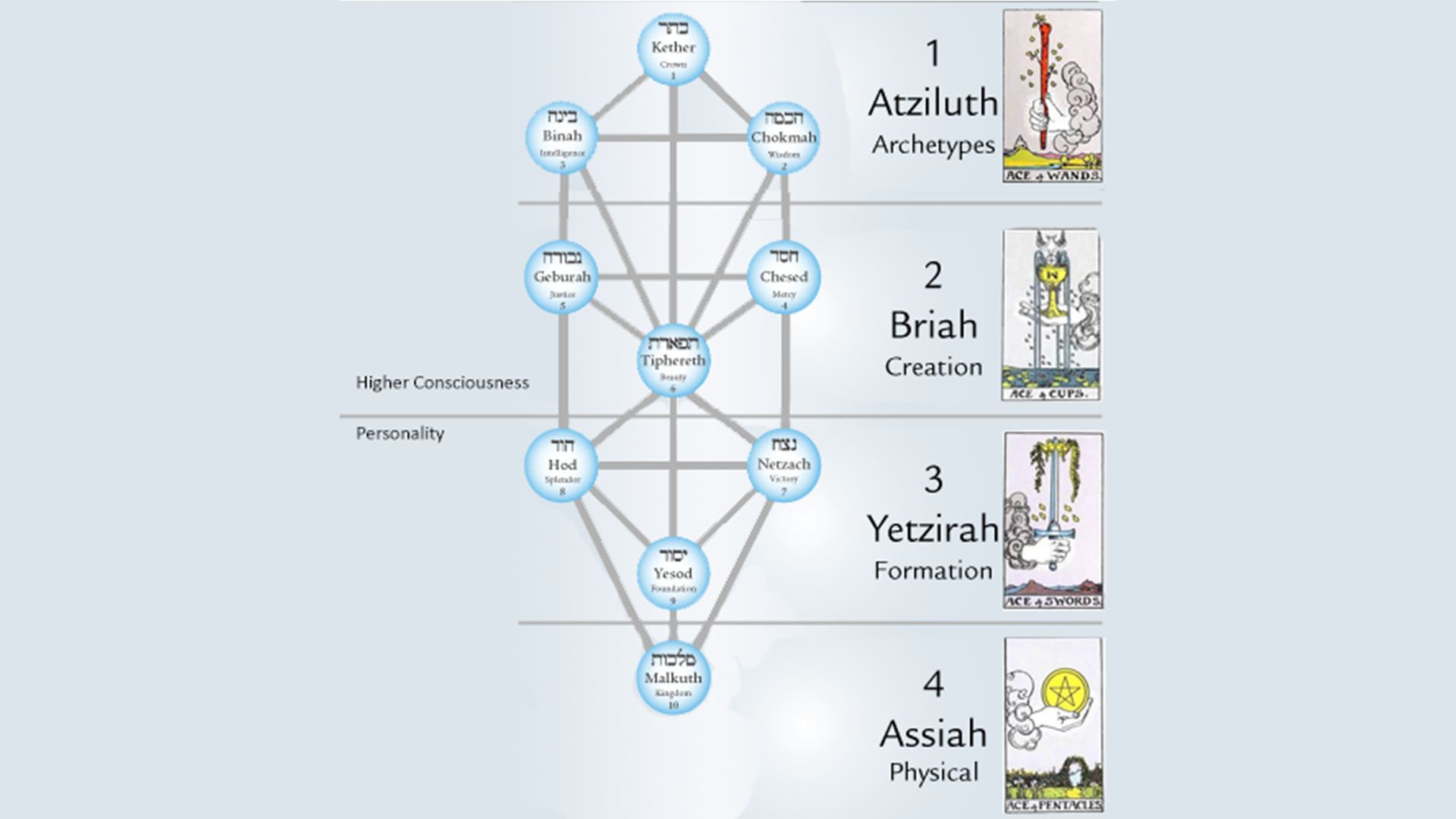
Here's the structure:
The Three Pillars:
Right Pillar (Pillar of Mercy): Expansive, giving, masculine energy
Left Pillar (Pillar of Severity): Contractive, form-giving, feminine energy
Middle Pillar (Pillar of Equilibrium): Balance and integration
The Ten Sephiroth (from top to bottom):
Kether (Crown): Pure, undifferentiated divine consciousness. The source before anything manifests.
Chokmah (Wisdom): The first spark of creative force. Pure potential begins to move.
Binah (Understanding): The container that gives form to force. Potential crystallizes into possibility.
Chesed (Mercy): Expansion, abundance, generosity. Building and growth.
Geburah (Severity): Restriction, discipline, destruction of what no longer serves. Necessary boundaries.
Tiphareth (Beauty): Harmony, balance, the heart center where all forces integrate.
Netzach (Victory): Emotion, instinct, desire. The realm of feelings and passions.
Hod (Glory): Intellect, reason, communication. The realm of thought and structure.
Yesod (Foundation): The subconscious, dreams, the astral template that underlies physical reality.
Malkuth (Kingdom): Physical manifestation. The material world you can touch and see.
Between these ten spheres run 22 paths—lines of connection that represent the ways consciousness can move between different states. And here's where tarot enters the picture: The 22 Major Arcana cards correspond exactly to these 22 paths.
This isn't a modern invention. The Sefer Yetzirah (Book of Formation), one of the oldest Kabbalistic texts dating to at least the 2nd century CE, explicitly describes 22 letters of the Hebrew alphabet as the building blocks of creation. Each letter corresponds to a path on the Tree, and each path corresponds to a Major Arcana card.
Mapping the Major Arcana to the Tree
When you shuffle a tarot deck and pull The Magician or The High Priestess, you're not just selecting a card with symbolic imagery—you're activating a specific pathway of consciousness on the Tree of Life. Each Major Arcana card represents a journey between two Sephiroth, a transmission of energy from one state of being to another.
Let me give you a few examples to show how precise this system is:
The Fool (Aleph) - Path from Kether to Chokmah:
The Fool isn't a random wanderer—he's the first movement of divine consciousness out of pure unity (Kether) into creative potential (Chokmah). The Hebrew letter Aleph means "ox" or "breath," the first exhale of creation. This is why The Fool represents innocence, new beginnings, the leap into the unknown. He's stepping off the cliff because he IS the creative impulse before it knows what it will become.
Traditional tarot interpretation: "The Fool means new beginnings, taking risks."
Kabbalistic understanding: "The Fool is the path by which infinite potential begins to move toward manifestation."
See the difference? One is vague encouragement. The other is metaphysical precision.
The Magician (Beth) - Path from Kether to Binah:
The Magician bridges the crown (Kether) to the sphere of form (Binah). Beth means "house"—the container, the structure. The Magician takes pure divine will and channels it into form through focused intention. His tools (Wand, Cup, Sword, Pentacle) represent the Four Worlds we'll explore later. He doesn't create from nothing—he directs what already exists in potential.
Traditional: "The Magician means willpower, manifestation, using your skills."
Kabbalistic: "The Magician is consciousness learning to shape the formless into form through focused will."
The High Priestess (Gimel) - Path from Kether to Tiphareth:
Gimel means "camel"—that which carries water across the desert, sustains life through barren places. The High Priestess is the path from the crown directly to the heart center (Tiphareth), representing hidden knowledge, intuition, the mysteries that can't be spoken but must be felt. She sits between the pillars of Severity and Mercy, the guardian of the threshold between conscious and subconscious.
Traditional: "The High Priestess means intuition, secrets, feminine energy."
Kabbalistic: "The High Priestess is the path of inner knowing that bypasses rational mind to connect divine source with integrated self."
I could continue through all 22 cards, but you see the pattern. Every Major Arcana card isn't a random archetype—it's a specific transmission route on the map of consciousness. When that card appears in your reading, it's showing you which pathway is active in the querent's psyche at that moment.
The Hebrew Letters and Their Esoteric Meanings
Each of the 22 paths is associated with a Hebrew letter, and these aren't arbitrary either. Hebrew is considered a sacred language in Kabbalah because each letter is believed to contain creative power—Sefer Yetzirah describes them as the tools God used to create the universe.
When you learn the Hebrew letter correspondences, you unlock another layer of meaning:
Aleph (The Fool): Breath, ox, the first sound—divine inspiration
Beth (The Magician): House, container—the vessel that holds intention
Gimel (The High Priestess): Camel—that which carries wisdom across thresholds
Daleth (The Empress): Door—the opening through which life emerges
Heh (The Emperor): Window—the structure that allows perception
And so on. Each letter adds nuance. The Empress isn't just "fertility and abundance"—she's Daleth, the door through which Binah's formative power manifests as physical creation. The Emperor isn't just "authority and structure"—he's Heh, the window that establishes boundaries so you can see clearly.
This is why memorizing generic tarot meanings leaves you frustrated. You're trying to remember arbitrary associations instead of understanding the underlying grammar. Once you know the Tree structure and the Hebrew correspondences, the cards stop being random symbols and become a coherent language.
Why This Was Hidden
If this system is so logical and powerful, why don't more tarot readers know about it?
The answer is historical suppression and cultural fragmentation. Kabbalistic teachings were intentionally kept secret for centuries, passed only from teacher to student within closed Jewish mystical communities. The knowledge was considered too potent, too easily misused, to be shared publicly. Medieval Christian Europe viewed Kabbalah with suspicion—sometimes tolerating it as "Christian Kabbalah," other times persecuting it alongside other Jewish practices.
When tarot emerged in 15th-century Italy as a card game, it wasn't originally connected to Kabbalah. That synthesis happened later, primarily through the work of French occultist Éliphas Lévi in the mid-1800s and the Hermetic Order of the Golden Dawn in the late 1800s. These groups, particularly the Golden Dawn, mapped the tarot onto the Tree of Life with meticulous care, drawing on centuries of Kabbalistic scholarship.
But here's the problem: The Golden Dawn was a secret society. Their teachings were oath-bound, available only to initiated members. When tarot entered popular culture in the early 20th century—particularly through Arthur Edward Waite's Rider-Waite deck in 1909—the Kabbalistic framework was deliberately simplified or removed entirely. Waite was a Golden Dawn member, but he created his deck for a general audience who wouldn't understand the esoteric correspondences. So we got beautiful imagery and vague symbolic meanings, divorced from the precise system that gave them structure. The result? A century of tarot readers working with a map that's had its legend torn off. The symbols are there, but the key to decoding them got lost in translation.
What you're learning in this guide isn't new. It's old—ancient, actually. I'm not inventing correspondences or making up associations. I'm teaching you what the cards were always meant to convey, the system that serious esoteric practitioners never stopped using even as mainstream tarot forgot its roots.
Now that you understand the Tree of Life and how the Major Arcana maps onto it, we can go deeper. The Major Arcana shows the structure of consciousness—but what about the Minor Arcana? That's where the Four Worlds come in.