The Lost Calendar of the Bible
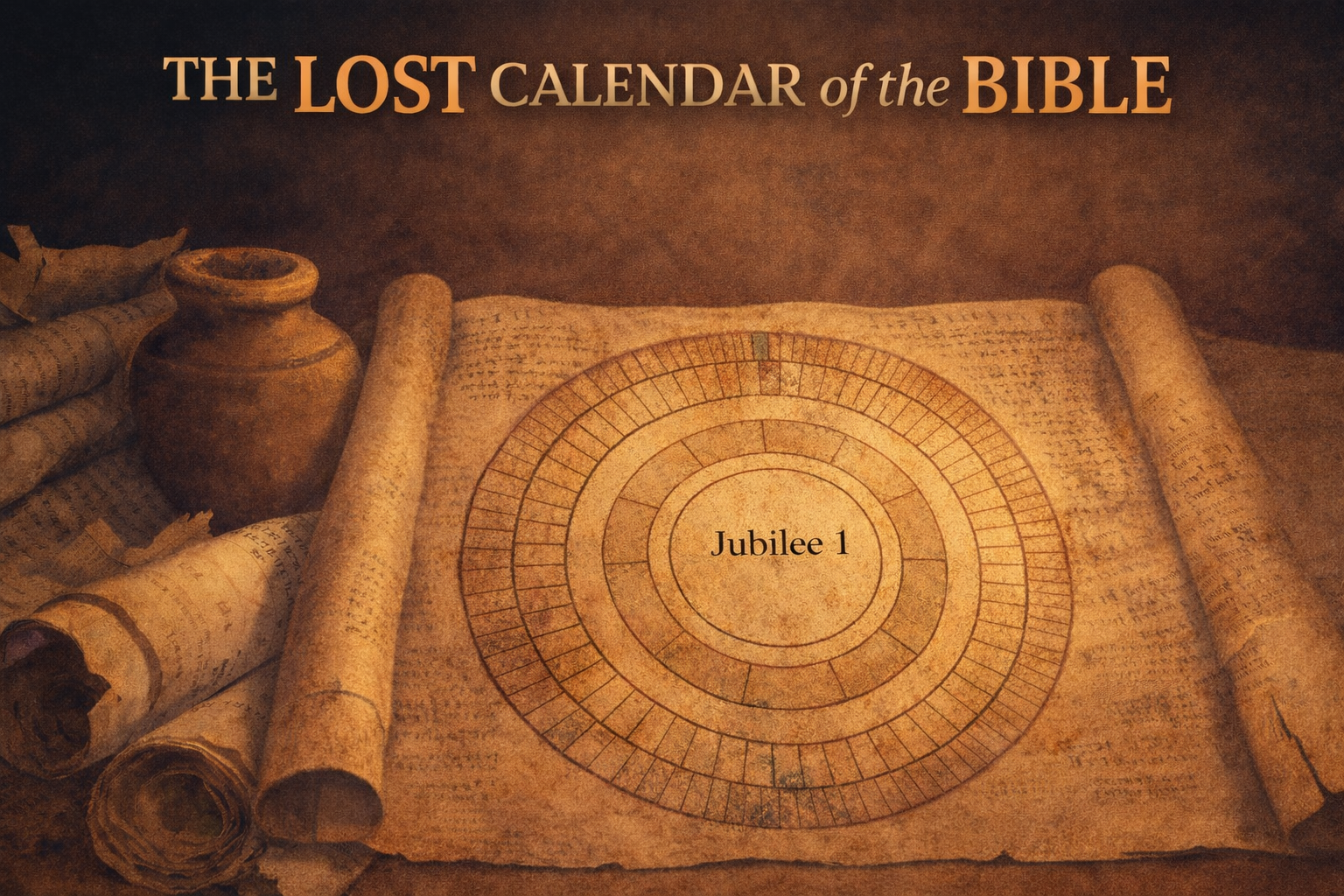
Sacred Time, Jubilee, and the Architecture of Biblical Meaning
Frater Lucis · 14 January 2026
In the mid-1940s, a remarkable discovery was made in the cliffs overlooking the Dead Sea near Qumran. Hidden in caves and sealed inside hundreds of clay jars were ancient manuscripts now known collectively as the Dead Sea Scrolls—biblical texts, commentaries, community rules, and calendrical writings dating back more than two thousand years. Their preservation alone was astonishing, but the greater question was never what was found. It was why these texts were hidden at all. Scrolls are not buried without reason. Someone made the deliberate decision to remove them from public life, to protect them from corruption, destruction, or control. And that decision leads us directly to a deeper conflict within Second Temple Judaism—one centred not only on theology or authority, but on something far more fundamental: the keeping of sacred time.
The Essenes, the Pharisees, and the Battle Over Time
To understand why the scrolls were hidden, we must understand who hid them—and what they were opposing.
By the late Second Temple period, Judaism was not a unified body but a constellation of competing interpretations. Two groups in particular stood in sharp contrast: the Essenes and the Pharisees. Their disagreement was not merely theological. It was temporal.
The Pharisees, whose interpretive tradition would later form the backbone of Rabbinic Judaism, followed a lunar-solar calendar. Months were governed by the sighting of the new moon, with intercalations added as needed to keep festivals aligned with the seasons. This system was flexible, responsive, and—crucially—administered by religious authority. Sacred time could be adjusted, declared, or delayed.
The Essenes rejected this entirely. Texts found among the Dead Sea Scrolls, particularly the Book of Jubilees and calendrical fragments such as 4Q319, reveal that the Essenes followed a 364-day solar calendar—perfectly divisible into weeks, with festivals falling on the same day every year. In their view, this was not a preference but a matter of divine order. Time itself had been established by God at creation and was not subject to human modification.
This conviction explains the Essenes’ severe language toward the Jerusalem priesthood. In the Community Rule (1QS), the Temple authorities are accused of walking in error, defiling sacred ordinances, and misleading the people. The charge was not simply corruption—it was misalignment. To keep the wrong calendar was to observe the right festivals at the wrong time, rendering even sincere worship invalid.
This concern over sacred time echoes earlier traditions preserved outside the later biblical canon. The Book of 1 Enoch, widely respected among Essene circles, contains detailed descriptions of the heavenly ordering of days, seasons, and years. The implication is unmistakable: heaven keeps perfect time, and the earth is expected to mirror it.
What emerges, then, is a fundamental rift. The Pharisaic system prioritised interpretive authority and adaptability. The Essene system prioritised cosmic alignment and mathematical precision. One treated time as something to be stewarded. The other treated it as something to be obeyed.
From the Essene perspective, the calendar used in Jerusalem had drifted out of harmony with divine order. Festivals were being celebrated on incorrect days. Sabbaths were miscounted. Sacred time itself had been broken. In such a context, withdrawal was preservation. And so the scrolls were hidden. Not because they were unimportant, but because they were too important to be left in a world that, in Essene eyes, no longer knew how to keep time.
How Sacred Time Was Forgotten
After the destruction of the Second Temple in 70 CE, Jewish life underwent a profound transformation. Without a central sanctuary, authority shifted from priesthood to scholarship. The traditions that survived were those that could be portable, adaptable, and teachable across dispersion. Over time, the Pharisaic model—already dominant in urban centres—became the foundation of Rabbinic Judaism. Its lunar-solar calendar, governed by human observation and later calculation, proved resilient in exile - the Essene calendar did not.
Communities that relied on a fixed solar year, tied to Temple service and cosmic symbolism, found themselves without institutional support. Their writings were not copied, taught, or publicly preserved. Some were sealed away. Others simply fell silent. By the early centuries of the Common Era, the very idea that Judaism once maintained multiple competing calendars had largely disappeared from collective memory.
Christianity followed a parallel path. The earliest followers of Jesus were Jews who lived within the rhythms of biblical sacred time—Sabbath cycles, festival seasons, and Jubilee expectation. Yet as the movement spread beyond its Jewish roots, the calendar that had structured Scripture was gradually reinterpreted rather than retained. Theological meaning was preserved, but temporal architecture was loosened. Feasts became commemorations. Cycles became anniversaries. Time was no longer something to be aligned with, but something to remember.
By the fourth century, Christianity had formalised its own liturgical calendar under imperial authority. While rich in symbolism, it was no longer anchored to the original biblical mathematics of weeks, years, and jubilees. Sacred time turned into ceremony, but the reasons for it faded from memory.
The result is the world we now inhabit. Scripture still speaks in the language of appointed times, fulfilled seasons, and measured years—but modern readers encounter these phrases metaphorically. The calendar that once made those statements concrete has been forgotten, buried beneath layers of tradition, translation, and institutional necessity.
And yet, it was never erased.
To recover sacred time is not to invent something new. It is to notice what was always there—and to recognise that the Bible does not merely tell a story in time. It reveals a story about time.
The Jubilean Structure of Sacred Time
The biblical calendar is not complex, but it is precise. At its foundation is a simple principle: time unfolds in ordered cycles of seven, each cycle nested within the next. This pattern appears so consistently across Scripture that it is easy to miss—precisely because it is everywhere.
The smallest unit is the week. Six days of creative labour culminate in the seventh day, the Sabbath—a cessation not born of exhaustion, but of completion. Time pauses because something is whole. This weekly rhythm is not merely practical; it establishes the grammar of sacred time itself.
Weeks then accumulate into years, and years into sabbatical cycles. As outlined in Leviticus 25, every seventh year is a Shemitah year—a year of release. Fields lie fallow. Debts are suspended. What was driven by effort is returned to trust. Time itself breathes.
Seven of these sabbatical cycles—seven times seven years—bring us to the threshold of the Jubilee.
After forty-nine years, the fiftieth year is declared holy. Property returns to its original families. Slaves are freed. Economic distortions are reset. What had drifted through accumulation is restored through rhythm. The Jubilee is not punishment or reward; it is recalibration.
What matters here is not only what happens during Jubilee, but why. The text is explicit: the land does not belong to the people, and the people do not belong to one another. Everything ultimately belongs to God. The calendar enforces this truth not through doctrine, but through time.
Seen this way, the Jubilee is not an isolated commandment. It is the capstone of a temporal architecture:
Seven days form a week
Seven weeks form a sacred season
Seven years form a sabbatical cycle
Seven sabbatical cycles culminate in restoration
Time moves forward, but it also returns. This structure reframes how Scripture speaks about fulfilment. When the Bible refers to “appointed times,” it is not speaking poetically. It is referencing a measurable framework in which meaning matures, ripens, and resolves. Nothing arrives randomly. Everything arrives on time.
Once this pattern is seen, it cannot be unseen. The biblical narrative is saturated with moments of sevens, releases, and completions—not as symbolism layered on top of history, but as the operating system beneath it. Which brings us to a critical realisation. If sacred time has a structure, then history is not merely a sequence of events. It is a movement through phases. And when Scripture declares that “the time is fulfilled,” it is not announcing an idea—it is marking a position within the calendar.
Where are we now, where have we been and what’s next? More to come…