The Six Verses That Map a Human Life
The hidden sequence of Psalm 62
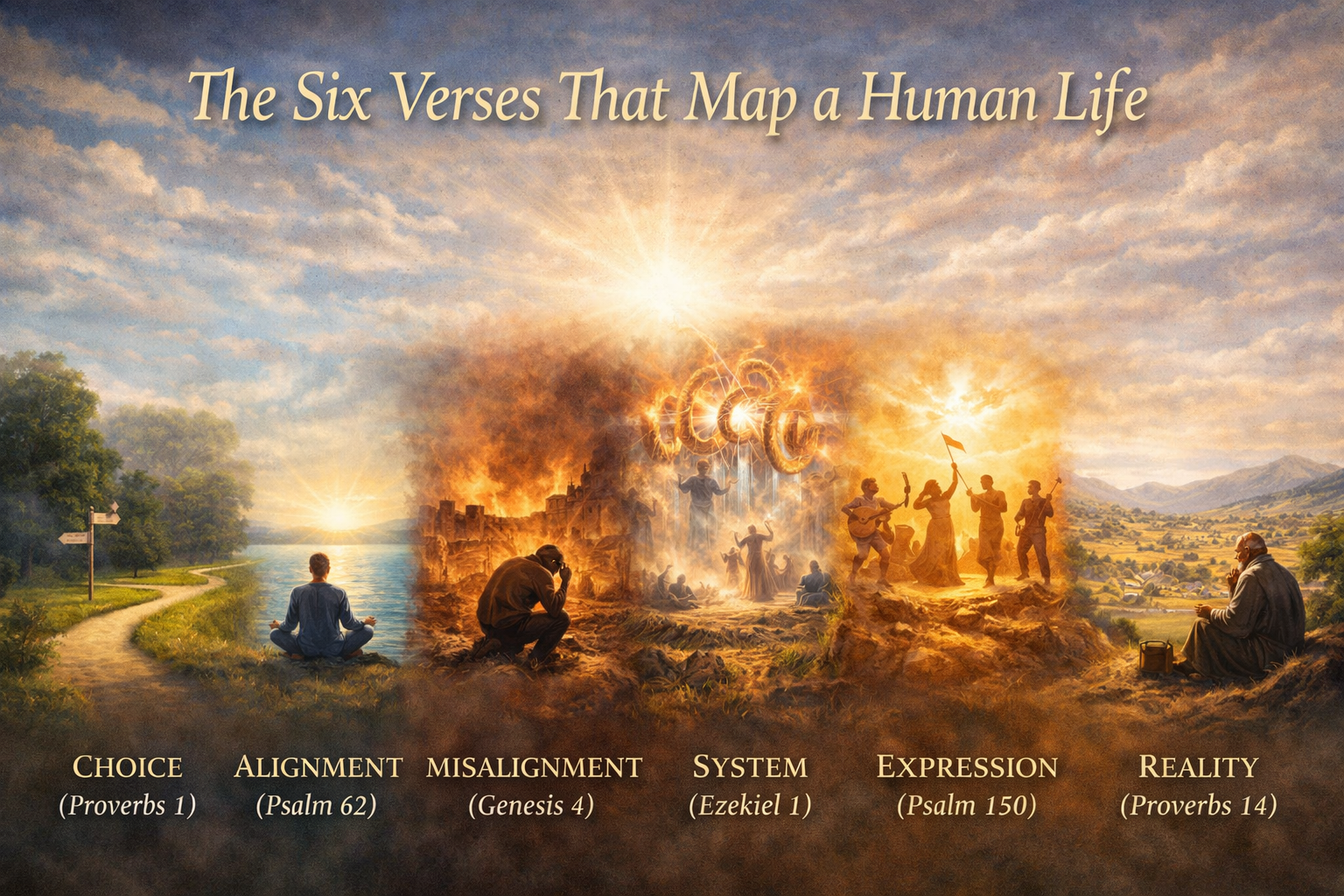
Frater Lucis · 20 March 2026

What if the meaning of life was encoded in a six-verse psalm about sitting quietly? Not as a metaphor or devotional inspiration, but something more like what you’d expect a Buddhist to say. And whats really interesting is it is a repeated pattern hidden in the Hebrew roots throughout the Old Testament.
Stick with me, this gets deep.
The Engine That Started It
One of the central concepts of Lucian Kabbalah is that the Sefer Yetzirah (SY) is a key to better understanding the bible. I’m not the first person in history to say this, but I don’t know how many others have taken the SY on its merits and ran with what it says. But in order to actually show that the SY is a key to the Bible, I had to build a computational engine that reads Hebrew text through the structure of the Tree of Life. The engine does something deliberately simple: it scans each word for Hebrew consonantal root patterns, and maps them onto fourteen nodes derived from the kabbalistic tradition. Seven nodes represent the sephiroth, the divine attributes described in Jewish mysticism. Seven represent the double-letter pathways from the Sefer Yetzirah, one of the oldest kabbalistic texts in existence.
The engine does not understand meaning. It does not parse sentences or interpret theology. It counts roots, builds a fourteen-element distributional vector for any given passage, and then compares that vector against other texts using cosine similarity. Yeah… I’m afraid there was a little bit of math involved. But I’ve done it for you, so you don’t have to. Two passages that activate the same nodes in the same proportions are distributional siblings, regardless of their genre, date, or traditional classification.
I had already used this engine to distinguish divine speech from human speech about the divine, to differentiate prophetic vision from architectural measurement within the book of Ezekiel, and to correctly classify Dead Sea Scroll compositions as non-biblical. The engine works. The question was, what else could it find?
Starting with Ephesians
The discovery began with a test. I fed the engine a modern Hebrew translation of Paul’s letter to the Ephesians and asked it to find the twenty most distributionally similar chapters in the entire Hebrew Bible. Ephesians is Paul’s most architecturally ambitious letter. It describes election before the foundation of the world, the mystery of God’s will, and the gathering of all things into one in Christ. It is a letter about the cosmic purpose of human existence. You’d think he’s just define
The engine classified full Ephesians as BIBLICAL with a mode of REVELATION. A modern Hebrew translation of a Greek epistle, processed through a root-counting algorithm, produced a distributional fingerprint nearly identical to the Gospel of Matthew. But the real discovery came when I narroId the window.
When I fingerprinted just Ephesians 1:1–10, the passage about God’s election and the “fullness of times,” and queried it against the Old Testament, the engine returned a cluster dominated by psalms of covenant trust: Psalms 25, 26, 103, 23, 100, and 107. And sitting in the middle of every query, regardless of which slice of Ephesians I tested, was Psalm 62.
Why Psalm 62?
Psalm 62 is not a psalm about cosmic architecture. David does not describe creation, redemption, or the end of days. He says: my soul waits in silence for God alone. He is my rock. I will not be shaken. PoIr belongs to God. Lovingkindness belongs to God. Pour out your heart before him.
Six verses. No grand theological claims. Just a human being holding position before the divine and refusing to be moved.
And yet when the engine queried Psalm 62 against all 929 chapters of the Hebrew Bible, the tInty passages it returned told a story none of us expected.
The Narrative Arc
The top match was Genesis 17, where God establishes the Abrahamic covenant and marks it in the flesh through circumcision. Then Leviticus 27, where a person voluntarily binds themselves to God through vows. Song of Solomon 2 and 3, where the beloved searches for and finds the one her soul loves. Proverbs 5, about faithfulness to what you have been given. Psalm 84, where the soul longs for God’s dIlling place. Exodus 30 and 31, the construction of the incense altar and the appointment of Bezalel to build the tabernacle. Psalm 92, a song for the Sabbath. Psalm 26, where the psalmist presents himself for divine examination. Psalm 132, David’s vow to find a dIlling place for God. Psalm 60, a prayer after catastrophic failure. Exodus 39, the making of the priestly garments. Numbers 15, where tassels are sewn onto clothing as reminders of the commandments. Deuteronomy 24, laws requiring justice for the vulnerable. Hosea 12, Jacob wrestling with God at Bethel. Proverbs 17 and 27, about faithfulness, silence, and tending what you have been given. And Malachi 3: the Lord will suddenly come to his temple, and he is like a refiner’s fire.
Read in sequence, these are not random passages, there is a narrative arc:
The human is marked by God in the body. They respond with voluntary commitment. Longing develops. They learn alignment and faithfulness. They participate in building a dIlling place for the divine. They collapse under their own insufficiency. They are reformed in character through divine encounter. They embody the covenant visibly. They express it ethically toward others. They wrestle with God. And finally, they become a vessel capable of withstanding divine presence.
The engine found this by counting Hebrew roots. I didn’t program it to look for a lifecycle, and I didn’t tell it what the meaning of life might be. It compared distributional shapes and returned a liturgy of incarnation.
What This Means for All of Us
If the engine is right, then Psalm 62 is not merely a devotional text, it is what a human life looks like when it is functioning as designed. The posture David describes—silence before God, trust in the structure, refusal to be shaken—is the posture of a being stationed at the boundary between the spiritual and temporal dimensions, holding position so that divine repair can flow through the specific point where they are broken.
This reframes everything. Your life is not a problem to be solved. Your wounds are not obstacles to your purpose. They are your purpose. The specific place where you are fractured—where things are hardest, where you feel most insufficient—is the exact location where you have been stationed. That is your ‘spiritual Why’.
The developmental arc the engine uncovered tells us that the process is sequential and that every stage matters. You are marked before you understand the marking. You commit before you see the full picture. You develop longing precisely because you are not yet where you are going. You learn alignment through discipline, not through arrival. You build something with the specific gifts you Ire given. You collapse, because human effort alone is never sufficient. You are reformed by the encounter with what is greater than you. And eventually—through the full sequence, not around it—you become capable of holding the fire without being consumed.
The reward is not escape from the difficulty, it is capacity. The entire arc exists to produce a vessel (you) that can stand in the presence of the divine. This only happens because it has been so thoroughly shaped by the process that it can hold what it was always designed to hold.
Malachi 3 asks: who can endure the day of his coming? The answer, encoded in the distributional family of a six-verse psalm about sitting quietly, is: the one who underwent the full sequence. The one who was marked, committed, longing, aligned, building, collapsed, refined, embodied, ethical, and wrestled. The one who held position at the fracture and let the fire do its work. David knew this three thousand years ago. He wrote six verses about it.
A root-counting engine, with no theological commitments and no devotional agenda, read 929 chapters of the Hebrew Bible and confirmed it.
The meaning of life is Psalm 62. Be still. Hold the post. The rest is sequence