The Supernatural Bible
How Modern Christianity Misses the Bigger Picture
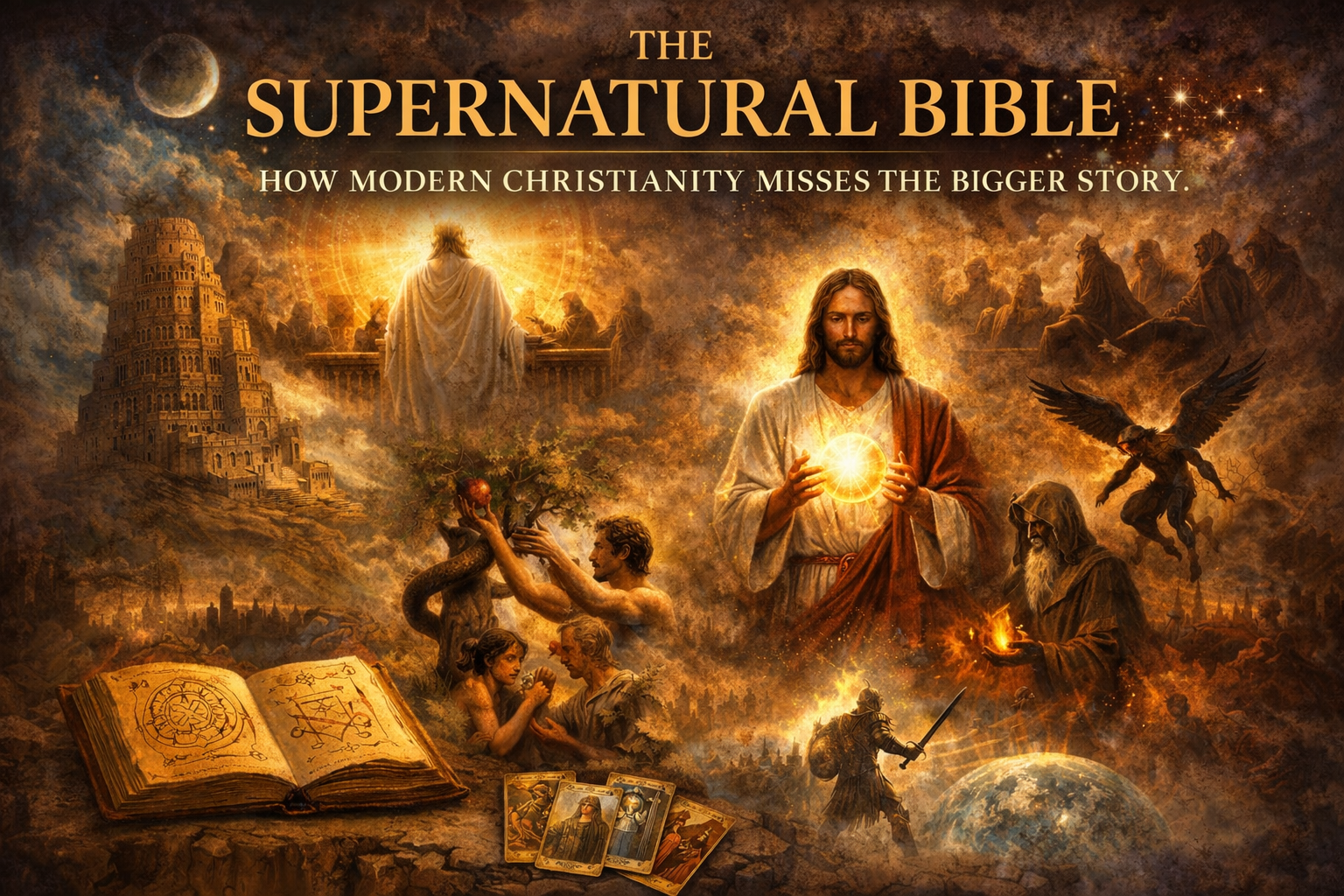
Frater Lucis · 22 December 2025
Lately, I’ve been doing what I always do when something feels off in the world—I’ve been hitting the books.
That’s meant deep-diving medieval grimoires, continuing work on the emanation app I mentioned previously, and returning—again—to the work of Michael Heiser.
If you’ve never encountered Heiser’s work, he was a biblical scholar who specialised in the supernatural worldview of the Bible—the parts quietly ignored in modern sermons. He wrote The Unseen Realm, Reversing Hermon, Angels, Demons, and maintained the wonderfully blunt website sitchiniswrong.com, where he systematically dismantled Zecharia Sitchin’s attempts at translating ancient Near Eastern languages.
In short, Heiser focused on everything your pastor, Sunday Mass, or modern theology tends to avoid—not because it isn’t in the text, but because it makes people uncomfortable. And that discomfort is where this story begins.
The Question That Started Everything
Heiser often said that his entire academic journey pivoted on two biblical passages—ones we’ve all heard, but rarely stopped to interrogate.
The first is Genesis 1:26:
“And God said, Let us make man in our image, after our likeness…”
The question should be obvious: who is “us” and “our”? The common answer is the Trinity—but that explanation collapses historically. Heiser describes this in great detail. The doctrine of the Trinity wasn’t formalised until centuries after Christ, while Genesis draws from oral traditions and written sources that predate Christianity by over a thousand years.
So what would an ancient Israelite have heard when they read this?
To answer that, you have to step outside modern theology and back into the ancient Near Eastern worldview—a world where kings ruled alongside councils, and high gods governed through assemblies of lesser divine beings. To them it wasn’t mythology - it was political and cosmic reality. Genesis isn’t borrowing pagan ideas. It’s speaking the shared language of its time. And that’s where the second passage comes in.
Psalm 82: The Passage No One Warned You About
The question raised in Genesis 1:26 doesn’t remain unanswered. It surfaces again—explicitly—in Psalm 82.
Psalm 82:1 (KJV):
“God standeth in the congregation of the mighty; he judgeth among the gods.”
This passage blew Dr. Heiser’s semenary eduction out of the water when he first investigated it—not because it was obscure, but because it was right there, preserved, untranslated away, quietly waiting. God—Elohim—standing in a council, judging other elohim. Psalm 82 was never removed from the canon because it wasn’t heretical to its original audience. It was too ancient, too embedded, and too well understood to be questioned. Only later did theology begin to flatten its implications.
And once you see it, you can’t unsee it. At that point, the Bible stops being a simple moral instruction manual and starts looking like something else entirely.
Respecting Heiser—And Where He Stops Short
I wish I’d had the chance to meet Dr. Heiser. His work is meticulous, brave, and deeply important. He restored something Christianity had forgotten: that the biblical authors believed they lived in a crowded spiritual universe. But I also think Heiser stopped short. Not because he was wrong—but because he was constrained. He placed himself in a difficult position: attempting to recover the supernatural worldview of the Bible (Divine Council, territorial spirits, rebellious elohim) while maintaining evangelical orthodoxy—a framework that explicitly forbids interaction with, navigation of, or operational understanding of the unseen realm. He recovered the map, but refused to walk the terrain. I understand why. Once you cross that line, you’re no longer just doing theology—you’re doing cosmology, ontology, and eventually, practice. And that’s where things get uncomfortable.
What Modern Christianity Thinks the Bible Is About
Modern Christianity—developed over centuries, not decades—offers a tidy narrative:
God creates a perfect world
Humans sin and fall
God works through Israel to prepare for the Messiah
Jesus comes, dies for sins, and rises
The Church spreads the Gospel
Jesus returns, final judgment follows, heaven or hell
The focus is personal salvation, moral behaviour, and the afterlife. And to be clear—this narrative isn’t false. It’s just the abridged version. It’s the cliff notes. Functional, institution-building, socially stabilizing—but incomplete. As we all know from school, Cliff Notes might help you pass a pop quiz, but then you often end up failing the final exam. It doesn’t lead to an informed existence.
What the Bible Is Actually Describing
When you stop filtering the text through modern doctrine frameworks and read it as a continuous ancient narrative, a very different story emerges. Not one about moral failure—but about jurisdictional rebellion. You are not living in a neutral world.
You are living in the aftermath of a cosmic war.
The conflict begins before humanity (rebellion in the heavenly order)
Continues in Eden (the nachash corrupting image-bearers)
Escalates with the descent of the Watchers (genetic and knowledge corruption)
Is reorganized at Babel (territorial assignments of nations)
Most territorial elohim rebel, becoming the “gods of the nations”
God selects one nation to preserve divine order
Prophets confront rival elohim and their systems
Christ enters as the perfect human, reclaiming authority
Death is defeated
Authority is redistributed
The Church becomes an invasion force—not an institution
The story ends with the restoration of all Creation
Each of these deserves its own exploration—and they will get one. Watchers. Babel. Divine Authority. All of it. This article is the foundation.
Your Role in This Story
If this worldview is true, then humanity’s role changes dramatically. You are not here to behave well and wait for heaven.
Your role is to:
Understand the structure of divine order
Know the authority under which you were born
Learn how alignment actually works
Reclaim territory through alignment with God Most High
And territory doesn’t mean land. It means influence. Consciousness. Families. Inner order. Systems. Every aligned human becomes a point of restoration in a fractured world. And yes—this extends into symbolism, tarot, cosmology, and the patterns hidden beneath religious language. We’ll get there.
A Final Thought for Christmas 2025
This Christmas, remember: Church is not an institution. It is not a building. It is not a hierarchy. Church is the divine energetic alignment you carry inside of you. Alignment—once understood—changes everything. Nothing in what you’ve read here diminishes the teachings of Jesus Christ. On the contrary, he was sent to distill this entire cosmic reality into something humanity could carry, live, and embody. It is all there in Luke 17:21, when he said, “for behold, the kingdom of God is within you”.