Tracing Biblical Events Through Literary Archaeology
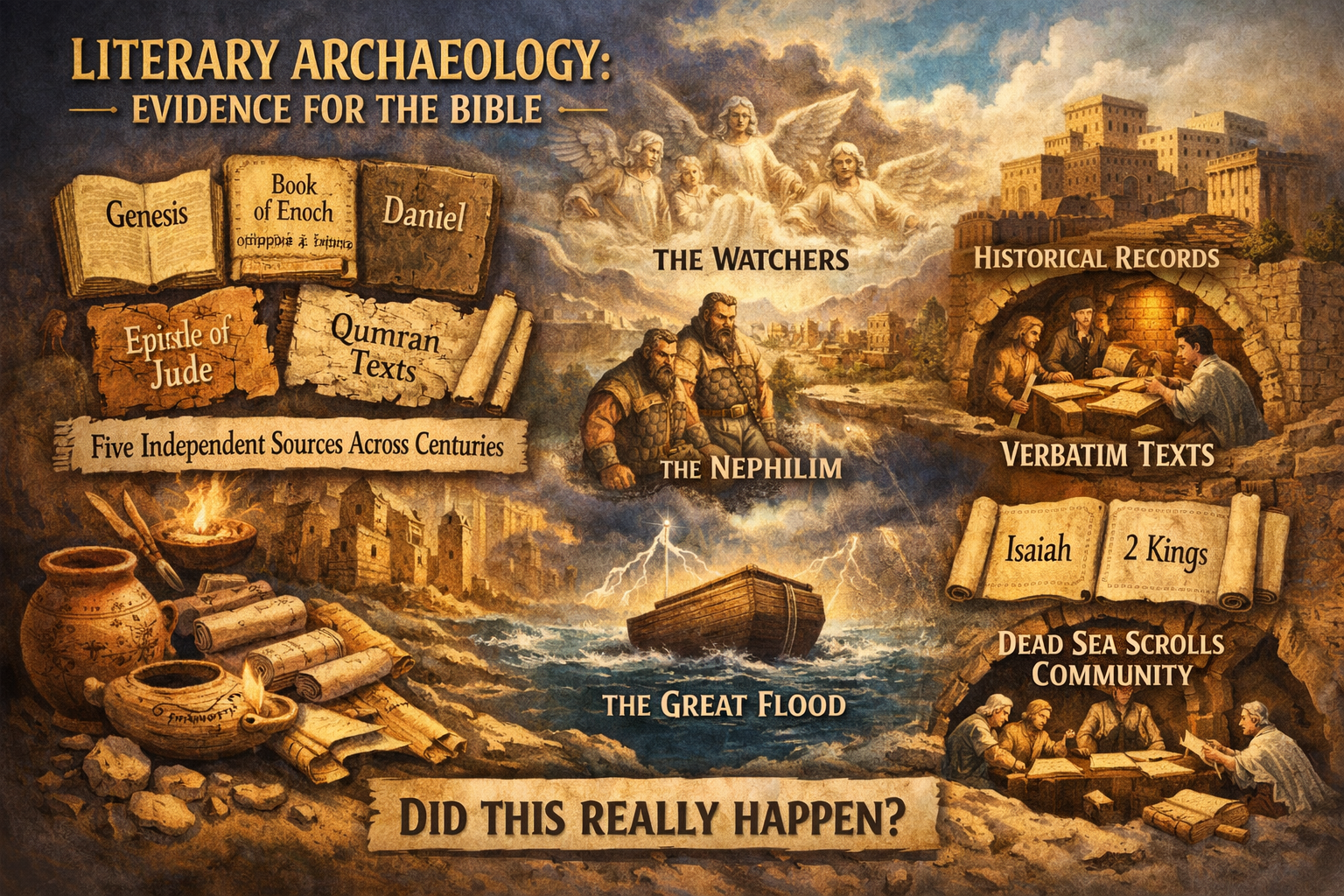
Frater Lucis · 30 March 2026
Someone asked me the other night, during a conversation about the ancient roots of natal chart work which taces back to Psalm 19: "Do we actually know any of this happened?" By that they meant the Bible. It's a fair question if your entire theological education is based on what the priest or pastor at your local church says at Sunday service. The quick dip that sunday service provides isn’t the same as a deep dive.
It is true, most of the people who wrote the books of the bible weren't there. Nobody alive was. But that's true of almost everything we accept about the ancient world. We weren't at the Battle of Thermopylae either, and nobody questions whether Sparta existed or that the battle occurred. So what makes us confident about any other ancient event? How do we determine the integrity of history at all?
Literary archaeology.
The same method historians use for every other civilisation on earth. The principle is simple, when multiple authors, writing in different centuries, in different languages, from different cultural positions, with no way of coordinating their stories, keep describing the same events, the same people, and the same cosmological reality, you are no longer looking at fiction. In a court of law it is called “corroborated evidence”. No prosecutor would dismiss it. No jury would ignore it… unless they have an agenda or preconceived notion.
And when you apply this method to the biblical texts and their surrounding literature, what you find is not a single book making one claim. You find a web of documents that corroborate each other in ways their authors could not have planned. I’ll break it down in a few examples below.
The Watchers: Five Independent Witnesses
Take the story of the Watchers, the angelic beings who transgressed their station. This is one of the most striking examples of literary convergence in the ancient record.
Genesis 6:2-4 describes "the sons of God" who saw the daughters of men and took them as wives, producing the giants (Nephilim) who walked the earth. It is a brief, almost cryptic passage. Just a few verses. If this were the only reference, you could dismiss it as mythology. But it is not the only reference.
The Book of Enoch, preserved in Ethiopic and recovered in fragments mentioned in the Dead Sea Scrolls, expands this account massively. It names the leaders of the fallen Watchers. It describes what they taught humanity and why they were judged. It was written centuries before the New Testament and survives in manuscript traditions that had no contact with each other for over a thousand years.
Then Daniel 4:17 uses the word "watchers" in a completely different context. The Babylonian king Nebuchadnezzar describes his dream, and the decree comes from "the watchers, and the demand by the word of the holy ones." Daniel was written in Aramaic and Hebrew, in a different period, for a different audience. Yet the same category of being appears, with the same function: celestial agents who observe and execute divine decisions.
Then Jude, writing his short letter in the New Testament period, references the same event. Jude 1:6 describes "the angels which kept not their first estate, but left their own habitation." And in verses 14 and 15, Jude directly quotes 1 Enoch, attributing a prophecy to "Enoch, the seventh from Adam." A New Testament author treating an extrabiblical text as authoritative witness.
Then the Dead Sea Scrolls community at Qumran produced the Book of Giants (fragments recovered from Caves 1, 2, 4, and 6), which expands on the same narrative. The giants, offspring of the Watchers, receive dreams warning them of the coming flood. This text was composed independently, in Aramaic, and was clearly considered scripture by the community that preserved it.
Five independent sources. Genesis, 1 Enoch, Daniel, Jude, and the Qumran Book of Giants. Written across roughly eight centuries, in Hebrew, Aramaic, and Greek, by authors with no way to sit in a room together and coordinate a story. All describing the same event and the same category of beings.
This all points to a cultural memory so significant, it could not be suppressed across a millennium of transmission.
The Flood
The Flood narrative follows the same pattern. Genesis 6 through 9 gives the canonical account. But a fragment known as 4Q370, recovered from Qumran Cave 4, is a rewritten account of the Noah story based on Genesis 6 through 9, composed independently by a community that treated the narrative as historical bedrock worth retelling for their own generation. The Book of Noah (fragments 1Q19, 4Q534-536) adds further details, suggesting a tradition of Noah literature that circulated alongside but independently of Genesis.
And then there's the broader ancient Near Eastern context. The Mesopotamian flood accounts (Gilgamesh, Atrahasis) describe a catastrophic deluge with a single righteous survivor, from a completely different cultural tradition. When Babylonian, Hebrew, and Second Temple Jewish sources all preserve a flood memory, across languages and centuries and civilisations that were often at war with each other, the literary archaeologist does not ask "Did this happen?" The literary archaeologist asks "What kind of event leaves this large a footprint?" The answer is, only an actual historical event.
Isaiah and Kings
There is another kind of evidence that literary archaeology reveals. When two biblical books, attributed to different authors, contain nearly identical text, it means either one copied the other or both drew from a shared official source. Either way, the event described was considered important enough to preserve with exact wording.
Isaiah 36 through 39 and 2 Kings 18 through 20 contain parallel accounts of the Assyrian siege of Jerusalem under Sennacherib and the illness of King Hezekiah. The prophet Isaiah appears in both accounts, speaking the same words, delivering the same messages. These passages are so close that scholars have debated for centuries which was written first. But the point for literary archaeology is this: two separate books in the biblical canon, attributed to different literary traditions (prophetic and historical), both considered this sequence of events important enough to record in nearly identical language.
Think of this like institutional record-keeping by a people from a single culture. It was history that greatly mattered to them.
The Community Rule
The Dead Sea Scrolls added another dimension entirely. The Community Rule (1QS), found in Cave 1 at Qumran, opens with instructions for the Master to "teach the saints to live according to the Book of the Community Rule." This scroll is not narrative though, it shows their method of liturgy and legal requirements of the priests. It describes how to enter the Covenant of God, how to pray at the coming of day and night, how to bless the Divine Name before going out or entering.
What makes this significant is that the Community Rule's theological framework, its references to Belial, to the Sons of Light and Sons of Darkness, to the Prince of Light (Michael) and the spirit of deceit, all map directly onto categories found in the biblical texts and 1 Enoch. An actual community, living in actual caves, organised their entire daily life around the same cosmological reality described in the prophetic and apocalyptic literature. They did not treat these texts as stories. They built a society on them.
What Literary Archaeology Actually Proves
It does not prove every verse is literal reporting. That's not what I’m saying, and it’s also not the point.
What it proves is that these texts describe a shared reality that multiple independent communities recognised, recorded, and built their lives around. The convergence of Genesis, Enoch, Daniel, Jude, the Qumran literature, and the Nag Hammadi texts (which, even from a different theological angle, engage with the same cast of beings and the same cosmological architecture) is not the product of conspiracy or copying. It is the archaeological footprint of events and realities significant enough to survive every attempt at suppression, translation, and cultural change across more than a thousand years.
When someone asks "Did any of this actually happen?", the honest answer is: something happened that was so significant, so real to the people who experienced it, that dozens of authors across nearly a millennium could not stop writing about it. They wrote in different languages, for different communities, with different theological commitments, and they kept describing the same thing.
In any other field of study we would call that evidence.