Types of Angels
Understanding the Difference in Biblical Mysticism
Frater Lucis · 12 January 2026
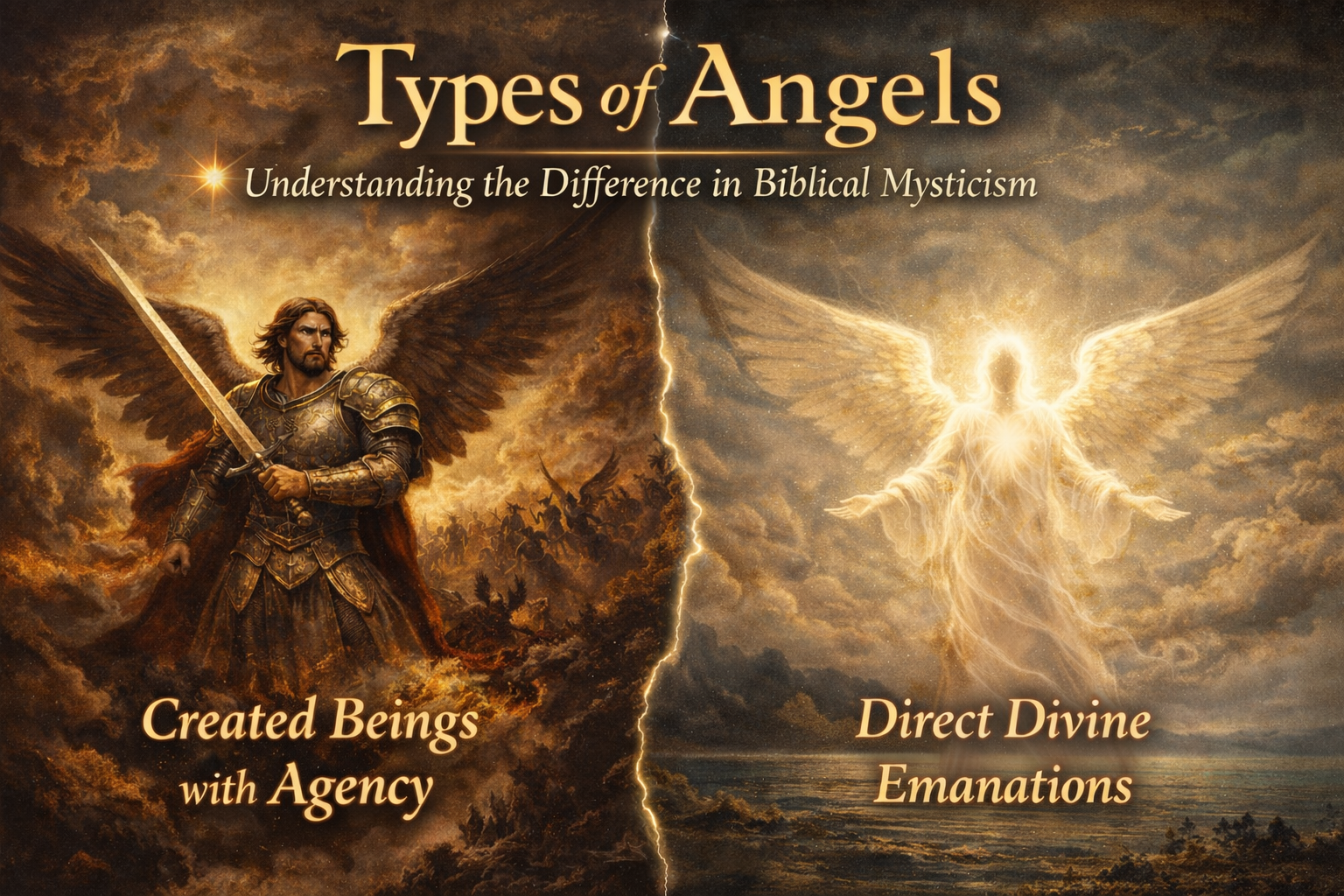
When we speak of angels in spiritual practice, we're often talking about two fundamentally different types of beings—though most practitioners don't realize it. This distinction isn't merely academic; it determines the safety, efficacy, and theological soundness of your entire spiritual practice.
The Two Categories of Angels
Angels as Created Beings with Agency
The first category encompasses what most people think of when they hear "angel": independent entities created by God who possess:
Free will and agency - They can make choices, including rebellion
Independent knowledge - They have limitations; for instance, they don't know the timing of Christ's return (Matthew 24:36)
Distinct personalities - They have names, roles, and individual characteristics
Permanent existence - Once created, they continue to exist as separate beings
The biblical evidence for this model is substantial. Revelation 12:7-9 describes Michael fighting against the dragon, suggesting an angelic being with warrior agency. Jude 6 and 2 Peter 2:4 reference fallen angels—entities that exercised their will to rebel against God. The very concept of rebellion requires independent agency; you cannot rebel against yourself.
These angels worship God (Revelation 5:11-12, Hebrews 1:6), which implies a fundamental distinction between worshiper and worshiped. They "long to understand" salvation (1 Peter 1:12), indicating they don't share God's omniscience. Colossians 1:16 explicitly states that "all things were created... whether thrones or dominions or rulers or authorities," placing angels firmly in the category of created beings ontologically separate from their Creator.
The classical archangels—Michael, Gabriel, Raphael, and Uriel—typically fall into this category in most mystical traditions. They're understood as powerful celestial beings with specific domains, personalities, and the capacity to act independently within God's will.
Angels as Direct Divine Emanations
The second category represents a profoundly different understanding: angels not as separate beings, but as extensions of divine will itself—God's own presence taking communicable form.
In this model, angels are:
Without independent agency - They don't choose; they simply are what God is doing
Perfect expressions of divine attributes - "Michael" isn't a being so much as God's mercy made manifest
Incapable of rebellion - You cannot rebel when you have no existence apart from God's will
Temporary manifestations - They appear and disappear as needed, like waves on an ocean
The Kabbalistic tradition particularly emphasizes this view. Angels here are understood as crystallized points where specific divine qualities become accessible to human consciousness. They're not separate from God in the way creatures are—they're more like focal points where the Infinite (Ein Sof) interfaces with finite reality.
Think of it this way: God is the ocean, and angels are waves with distinct forms and names. The wave isn't separate from the ocean, but it has a temporary, purposeful shape. When you engage with such an angel, you're not contacting a separate being—you're interfacing with a specific frequency of divine emanation.
The Biblical Evidence for Divine Emanations
The most compelling scriptural support for this second model comes from the mysterious "Angel of the LORD" passages in the Hebrew Bible.
In Genesis 16:7-13, the Angel of the LORD appears to Hagar, but speaks as God Himself. Hagar responds by saying she has "seen God." In Exodus 3:2-6, an angel appears in the burning bush, but then identifies himself as "I AM"—the divine name itself. In Judges 13:21-22, Manoah realizes that the angel who appeared to them was actually the LORD, causing him to fear death from having seen God face-to-face.
These passages resist clean categorization. The text oscillates between describing the figure as distinct from God ("the angel said") and identifying the figure as God Himself ("I am the God of your fathers"). This tension suggests we're dealing with something more complex than a simple messenger—we're encountering God's direct presence taking a form humans can perceive and engage with.
Psalm 104:4 describes God making "his angels winds, his ministers a flaming fire"—language suggesting they're shaped and formed for tasks rather than existing as permanent, independent entities.
The 72 Shem HaMephorash: Pure Divine Emanation
The clearest example of pure divine emanation in Jewish mystical tradition is the 72 Shem HaMephorash—the 72 names of
God derived from Exodus 14:19-21.
These aren't names of separate angelic beings. They're specific three-letter combinations extracted directly from God's speech during the parting of the Red Sea. Each represents a particular "frequency" or aspect of divine power:
Vehuiah (1) - Divine will and new beginnings
Cahatel (16) - Protection and blessing
Hahasiah (51) - Hidden wisdom and universal medicine
Mumiah (72) - Endings and rebirth
These names have no independent existence. They don't possess agency. They cannot be fallen or corrupted. They simply are God—specific bandwidths of the divine presence made accessible through Hebrew wisdom. When a practitioner works with the Shem angels, they're not summoning separate entities. They're attuning to divine frequencies. It's less like calling someone on the phone and more like tuning a radio to receive what God is already broadcasting.
Why This Distinction Matters for Practice
Understanding whether you're working with created beings or divine emanations has profound practical implications:
Safety Considerations
Created beings with agency can be impersonated. If you're calling upon Michael or Gabriel as independent entities, you face the risk of chthonic (underworld) forces responding to that call while wearing an angelic mask. Predatory spiritual entities are experts at deception, and they can masquerade as angels of light (2 Corinthians 11:14).
Divine emanations cannot be counterfeited in the same way. When you attune to Cahatel—a direct expression of God's protective nature from Exodus 14—you're engaging with God Himself. There's no intermediary to impersonate. Chthonic entities may interfere with your reception of that frequency, but they cannot pose as the frequency itself.
Theological Integrity
Working with created angelic beings as intermediaries raises the question of idolatry. Are you positioning them between yourself and God? Are you attributing to them powers that belong to God alone?
Working with divine emanations avoids this problem entirely. You're not appealing to intermediaries; you're engaging different aspects of the one true God. It's theologically equivalent to praying to "God as Healer" versus "God as Judge"—you're directing your attention to specific divine attributes, not separate beings.
Practical Efficacy
Created beings can say no. They can be busy elsewhere. They can have their own agendas (even if aligned with God's ultimate purposes). Your request must align with their will and availability.
Divine emanations are always available because they're not "beings" with schedules and priorities. They're aspects of God's eternal now. When you attune to Hahasiah for wisdom, you're not asking someone to show up—you're opening yourself to receive what God is perpetually offering.
The Hybrid Reality
Here's where it gets more complex: Scripture seems to present both models simultaneously without resolving the tension.
It's possible that:
Different types of angels exist on a spectrum - High-level manifestations (like the Angel of the LORD) function as pure divine emanation, while lower-order angels (messengers, guardians) are created beings with agency.
Angels are ontologically created but functionally emanations - They exist as separate beings, but when perfectly aligned with God's will, they become pure channels of divine action—temporarily indistinguishable from God's direct presence.
Both categories exist independently - Some encounters involve created angelic beings; others involve direct divine manifestation. Discerning which is which requires spiritual wisdom.
Practical Application
For those engaged in mystical practice, I recommend prioritizing work with what you can confidently identify as divine emanation:
The 72 Shem HaMephorash - These derive directly from God's speech in Exodus and represent pure divine frequencies
The Angel of the LORD - When Scripture identifies an angel as the LORD Himself, you're dealing with divine emanation
Sefirotic forces - The ten emanations on the Tree of Life represent how the Infinite becomes comprehensible
Reserve work with named archangels (Michael, Gabriel, Raphael, Uriel) for traditions where their role as either created beings or emanations is clearly defined and you've established proper discernment protocols.
The Most Important Point
Whether an angel is a created being or divine emanation, the ultimate focus must remain on the Most High God Himself. Angels—of whatever type—are not sources of power. They're not worthy of worship. They exist (in whatever way they exist) to point us toward the one true Source.
The goal of mystical practice isn't to accumulate angelic contacts or master spiritual entities. It's to deepen our relationship with God—to align our will with divine will, to perceive divine presence more clearly, to participate in the work of redemption and restoration.
Angels, whether creatures or emanations, serve that greater purpose. Never let them become the destination rather than signposts on the journey.