What Exorcism Actually Is
Deliverance, Divine Order, and the Work of the Spiritual Advocate
Frater Lucis · 9 March 2026
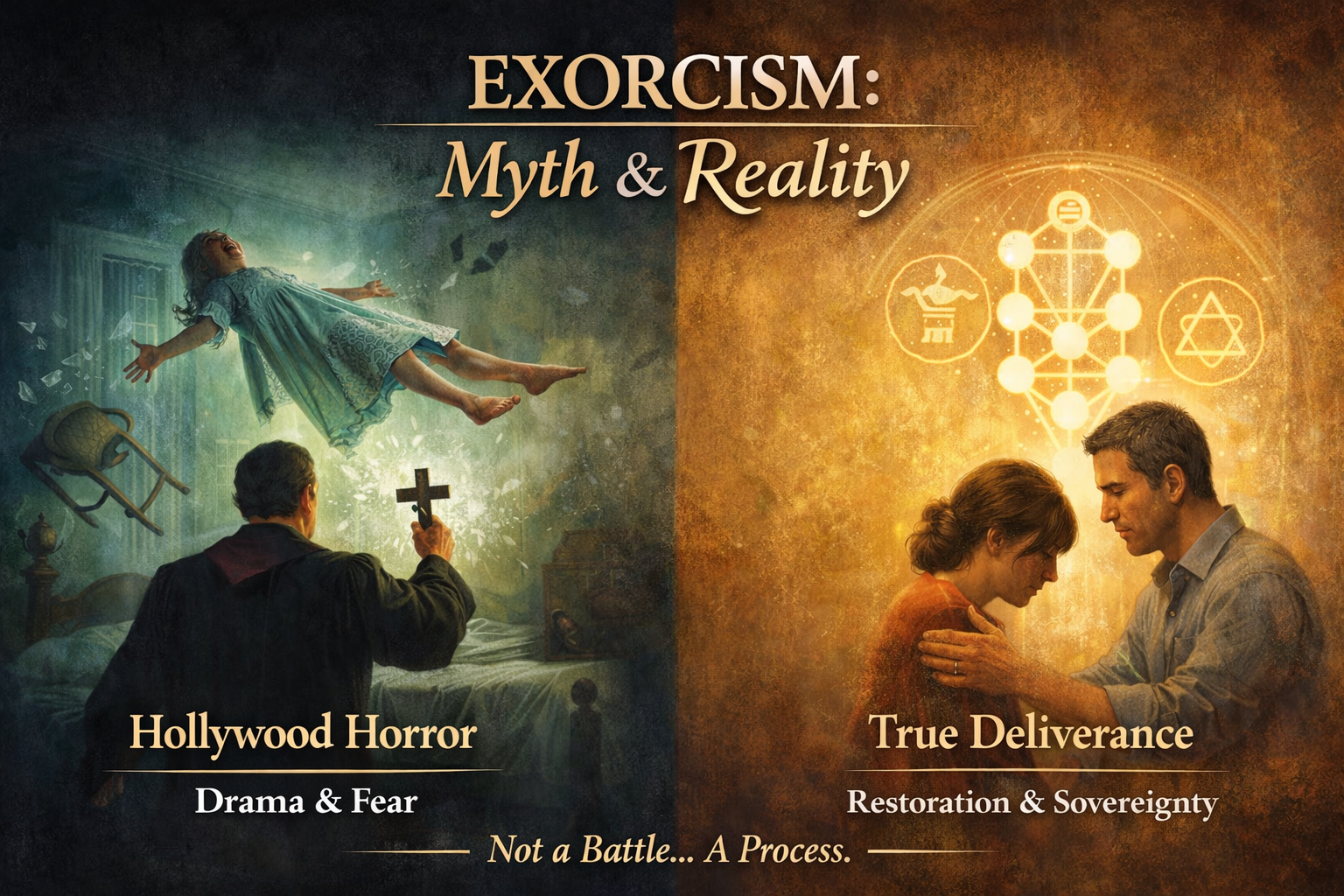
The word exorcism tends to do one of two things to people. It either summons the image of a Hollywood priest hurling holy water at a levitating child — head spinning, furniture flying, the forces of darkness defeated in a single dramatic night. Or it triggers a more modern kind of embarrassment, the polite discomfort of people who consider themselves too sophisticated for that kind of thing. Both responses, in their own way, miss what is actually happening when genuine deliverance work is done.
What actually happens is neither cinematic nor embarrassing, and it is far more interesting than the mythology surrounding it.
The Hollywood Version and Why It Persists
The popular image of exorcism comes from a specific cultural moment — mid-twentieth century horror, filtered through a particular strand of Catholic ceremonial theatre, amplified by cinema into something almost entirely divorced from the actual tradition. In this version, the exorcist is a heroic individual confronting a powerful entity in a battle of wills. The entity is identified, commanded, and expelled. The afflicted person is passive — a vessel, a victim, a battleground. The whole thing resolves in a night.
This version persists because it is dramatically satisfying. It externalises evil completely, makes the afflicted person blameless and helpless, and positions the exorcist as the sole agent of resolution. It is also, in almost every meaningful respect, a distortion of what the tradition actually describes.
The actual tradition — across Jewish, Christian, and broader Near Eastern sources — presents something considerably more nuanced. The afflicted person is not simply a passive vessel. The process is not resolved in a single encounter. And the practitioner's role is not that of a warrior commanding dark forces into submission.
What Is Actually Being Addressed
Within the framework I work from — the Lucian Kabbalah, reality operates through three interpenetrating dimensions:
The Divine dimension, which is beyond time.
The Spiritual dimension, which contains a hierarchy of beings operating in the intermediate realm.
Material and Temporal dimension, where we live — where transformation, narrative, and genuine becoming are possible.
This last dimension — the temporal — is not a lesser realm. It is the only dimension where change is possible. Time is not decay, it is the engine of transformation. This is why the material world is treated as sacred in this framework, not as a prison to escape but as a temple in which the story of becoming actually unfolds.
Within this understanding, certain categories of spiritual beings find themselves in what the tradition calls a stuck state — they have exited the flow that connects creation to its source. They cannot approach the Divine presence. They exist in a liminal condition, neither fully operative nor fully resolved, awaiting a judgment whose timing is unknown. Some of these beings are drawn to embodied, temporal existence precisely because they no longer have access to it. And some, in their displacement, attempt to re-enter the temporal flow by occupying space that was never theirs.
This is what deliverance work addresses. Not a dramatic battle between good and evil, but a jurisdictional problem. Someone is occupying space that belongs to someone else. A sovereign image-bearer — a human being created in the divine image, with an inalienable right to their own temporal existence — has had their boundaries violated. The work of deliverance is the restoration of those boundaries to their correct state.
Sovereignty: The Principle That Changes Everything
The central principle in my practice is what I call the Melqart Principle: sovereignty is sacred and non-negotiable. No being, regardless of power or rank, has the right to violate another's will within divine order. This is not simply an ethical preference. It is a structural feature of how reality is organised. Beings that operate by violating sovereignty as their primary mode are, by that very fact, operating outside the divine order — which is precisely why they are stuck.
This principle has an immediate and practical consequence for how deliverance work is done. The afflicted person is not a passive victim requiring rescue. They are a sovereign being whose boundaries have been violated, and the work of restoration is fundamentally about re-establishing their own standing — not about a practitioner doing battle on their behalf.
The practitioner's role is closer to that of a legal advocate than a warrior. In the Hebrew tradition there is a figure called the melitz — an interpreter and advocate who understands both the human situation and the divine legal framework, and who can present a case correctly before the appropriate level of oversight. The melitz in the Book of Job is described as one among a thousand — a rare figure who knows divine law, understands human suffering, and can speak accurately between them. That is the function I occupy in this work. Not commanding forces. Not doing battle. Presenting a case, through correct channels, for the restoration of right order.
Why It Is a Process, Not an Event
The single-night dramatic resolution of Hollywood exorcism fails not just cinematically but structurally. Genuine deliverance work takes time because what is being addressed is rarely simple occupation. More often it is a combination of factors — a structural vulnerability in the person's natal architecture that created an opening, patterns of misalignment that deepened over time, and one or more displaced entities that moved into the space those patterns created.
Think of it this way. A house with a damaged foundation and broken locks is more vulnerable to unwanted occupants than a house that is structurally sound. Removing an occupant without repairing the foundation and the locks simply means the space is available again for the next one. This is why so many people who undergo dramatic single-session deliverance find the same or similar problems returning within months. The occupant may have been displaced. The structural conditions that permitted the occupation were not addressed.
Genuine deliverance work therefore involves at minimum three phases. The first is diagnosis — understanding the person's structural architecture, identifying where the vulnerabilities lie, and determining what has moved into those spaces and from which level of the hierarchy it is operating. The second is advocacy — bringing the situation correctly before the commissioned oversight whose jurisdiction this falls within, petitioning for the restoration of right order through proper channels. The third is consolidation — addressing the structural conditions that created the vulnerability in the first place, so that the restored boundaries hold.
This third phase is often the longest and the most demanding. It requires the person's own active participation. Their sovereignty is the asset. Their alignment is what makes the restored boundaries durable. A practitioner can advocate on their behalf and help establish the initial clearing. Only the person themselves can maintain what has been restored through their own ongoing choices and orientation.
The Distinction That Matters Most
There is a distinction in the tradition between what might be called commanding and petitioning — between approaching displaced entities as a power that can compel them, and approaching the divine order as a legal framework within which their presence is a recognised breach.
The commanding approach has a long history in ceremonial magic and in certain strands of Christian deliverance ministry. The practitioner invokes authority — either their own initiated authority or the authority of a divine name — and commands the entity to depart. This can work. It can also go badly wrong, and the tradition is honest about this. Commanding an entity requires that your authority actually exceeds theirs, which is not a given. It also positions the practitioner in a power contest, which is precisely the register that displaced entities are most practised at operating in.
The petitioning approach is different in kind. Rather than asserting personal authority over the entity, you are presenting a case to the commissioned oversight whose domain this falls within. You are not the power that removes the entity. You are the advocate who correctly frames the jurisdictional violation and brings it before those with the actual authority to address it. This is not weaker than the commanding approach. It is more precise, more aligned within the Divine Heirarchy, and considerably safer. The practitioner’s effectiveness depends on their knowledge of the framework and the accuracy of their presentation, not on a power contest you may or may not win.
The language of this approach reflects the distinction. Not: I command you to leave. But: This temporal body belongs to this soul in this timeline. Your presence here is a breach of divine order. The commissioned oversight whose jurisdiction this falls within has been petitioned. Withdraw. The practitioner works with the divine heirarchy, so that they do the commanding of the entity.
That is a legal declaration, not a power contest. And it operates from the most stable possible foundation: the actual structure of divine order, which the displaced entity has already violated simply by being where it is.
What This Means for the Person Seeking Help
If you are reading this because you are experiencing something you cannot explain — a persistent sense of occupation, patterns that feel externally imposed rather than internally generated, a quality of interference that your own will seems unable to resolve — there are a few things worth understanding before you seek help.
First, genuine deliverance work is not dramatic and it is not instantaneous. Anyone promising a single session resolution is either working at a level of the problem that does not address the structural conditions, or is overstating what they can deliver. Be appropriately sceptical of theatrical approaches.
Second, your sovereignty is the most important asset in the entire process. A practitioner can advocate on your behalf and help establish the initial clearing. They cannot maintain what is restored for you. That requires your own ongoing alignment, your own choices, your own orientation toward the flow that connects creation to its source. The work is done with you, not for you.
Third, there is a difference between spiritual interference and psychological difficulty. These can co-exist, and often do — but they require different approaches and neither one should be treated as a substitute for the other. Genuine deliverance work does not replace appropriate psychological or medical support. A practitioner who suggests it does is overstepping their actual function.
Finally, and most importantly, the fact that transformation is possible while you are embodied in time is not a small thing. It is the most significant fact about your situation. Whatever has moved into your space, whatever patterns have developed, whatever structural vulnerabilities exist in your architecture — none of these are permanent while you are alive and in time. The temporal dimension is precisely the dimension where the stuck can become unstuck, where what has been violated can be restored, where the story can still move in a different direction.
That is not false optimism. It is the structural reality of what time is for.