What is the Qlippoth & Why Does Evil Exist?
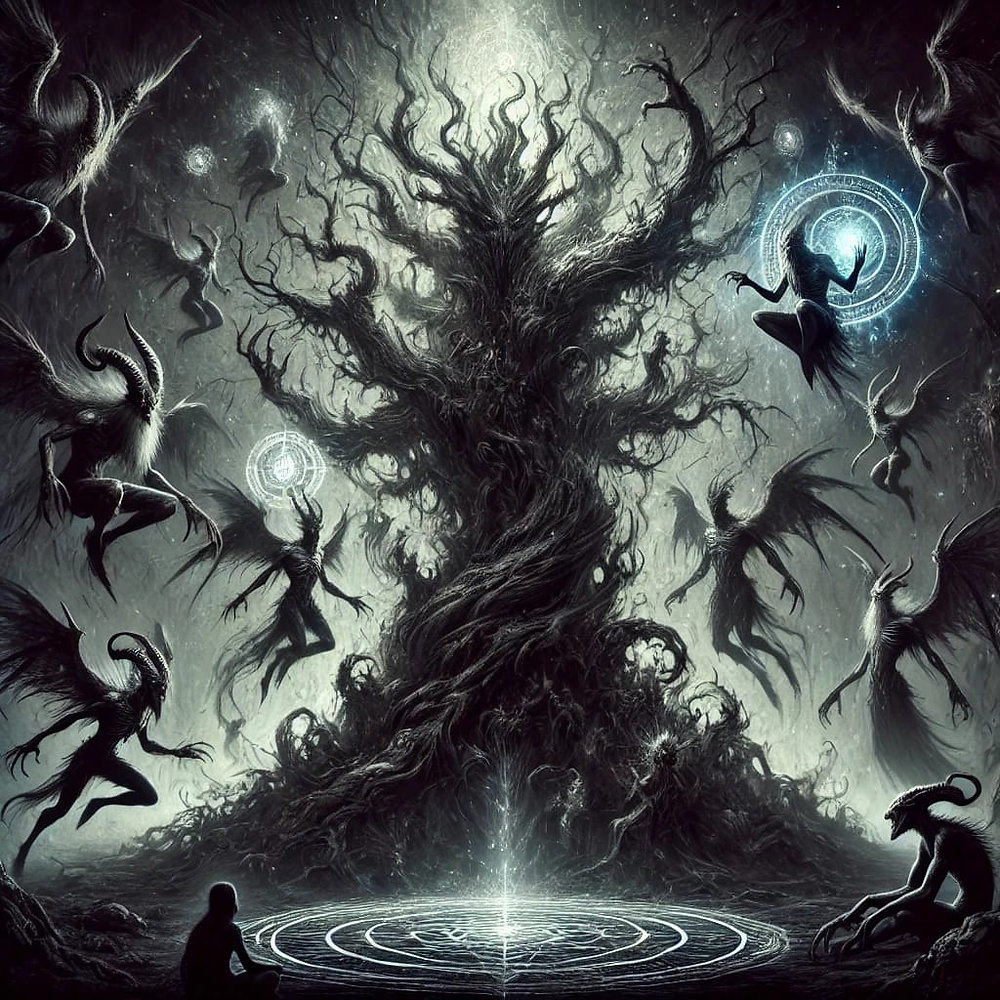
Frater Lucis · 6 November 2025
Most people who encounter the word Qlippoth (קליפות) hear it whispered like a curse — a term associated with dark forces, demonic realms, or forbidden knowledge. It is partly true, but long before you get to such a hardened, calcified spiritual state, the Qlippoth most often have to do with the parts of ourselves, or life, that have been cut off from the benefits of wisdom, understanding, and acceptance. They are what happens when divine energy stops moving — when something once alive, inspired, or true becomes rigid, repetitive, and disconnected from its source.
The Hebrew word qlippah literally means “shell” or “husk.” It is what remains when the fruit has been eaten — form without essence, structure without spirit, memory without presence. Wherever revelation ceases, a shell begins to form. And this doesn’t just happen in the cosmos — it happens within each of us, every day.
The Problem of Evil & Why it Exists
What we call evil is not a rival to God, but a symptom of divine necessity. Without resistance, there could be no revelation. The Qlippoth exist because creation required containers — forms capable of holding light — and not all could bear its intensity. Their shattering was not a cosmic mistake but a sacred tension built into the fabric of manifestation. The shells are what give consciousness its friction, its edges, its choice. Through them, awareness learns discernment; through contrast, the soul discovers will. Evil, in this sense, is not an independent force but the echo of divine light encountering limitation. To redeem it is not to erase darkness, but to remember that even in its most distorted state, it is still made of the same original fire.
The Misunderstood Shadow
In the Living Tree — the diagram of divine emanation — light descends from the Infinite (Ain Soph Aur) through the ten
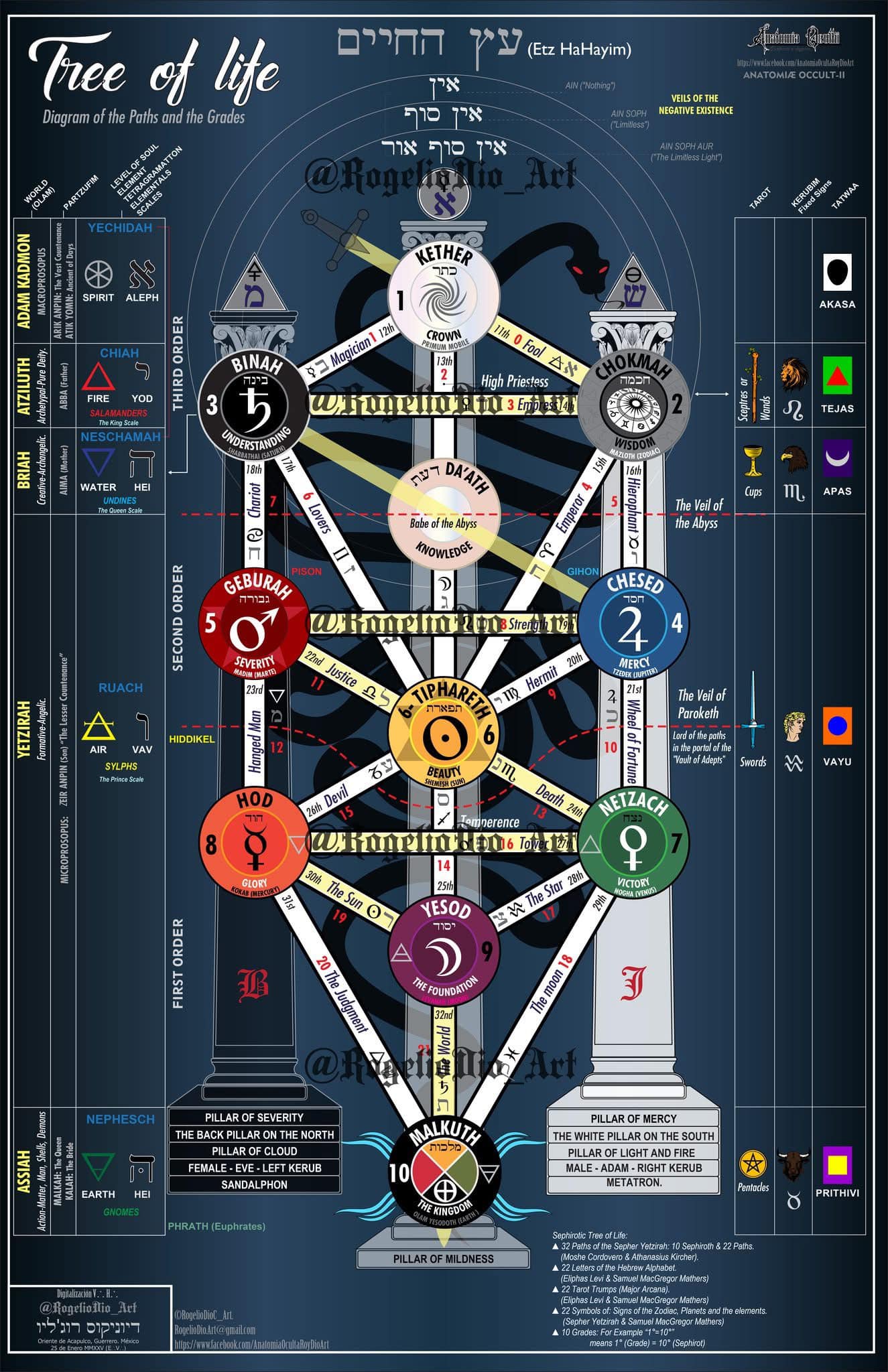
sephiroth, each one shaping the raw radiance of the divine into more specific expressions of being. This is the process of creation itself: the descent of spirit into matter, of idea into experience. But when that flow of emanation stops — when a sephirah becomes isolated, clinging to its own brilliance without passing it onward — its light begins to crystallize. What remains is the residue of that divine current: the Qlippoth. The Qlippoth are the spiritual fossils of divine movement that refused to evolve. They are not to be hated, for they once carried light. But they must be understood, lest we mistake their lifeless echo for the living voice of God.
How the Qlippoth are born or formed
Kabbalists describe the original “breaking of the vessels” (Shevirat ha-Kelim) as the moment when divine light poured into forms too fragile to contain it. Those vessels shattered, scattering sparks of holiness into the lower worlds. The shards that remained — the qlippothic shells — became the husks of separation and inertia. In psychological terms, this is what happens when we resist change or cling to old identities. Every time the soul experiences something and refuses to grow from it, the light of that lesson becomes trapped. It forms a shell.
The shell of fear forms when love is withheld.
The shell of shame forms when authenticity is denied.
The shell of pride forms when wisdom is claimed as possession.
And the shell of despair forms when hope forgets its source.
Each of these is a microcosmic Qlippah — a spiritual crust around a forgotten spark.
The Qlippoth, then, are not external demons. They are the unmetabolized experiences of creation — energies that were meant to pass through us but instead became prisons.
The Greatest Trick of the Qlippoth
One of the most subtle Qlippothic influences of our time is the belief that we are beings within time rather than beings through whom time flows.
When we identify completely with our history — our wounds, habits, and accomplishments — we fall under the spell of repetition. Life becomes a loop of reactions rather than a current of revelation. This is Qlippothic consciousness: energy trapped in yesterday. In practical terms, it appears as:
Overthinking the past or worrying compulsively about the future.
A sense that life has become stagnant or devoid of meaning.
Creative burnout, where inspiration feels mechanical.
Emotional numbness — a feeling that the soul is “offline.”
These are not moral failings. They are symptoms of energy that needs movement.
The solution is not escape but circulation: allowing light to flow again through awareness, forgiveness, and inspired action.
Redeeming the Shells
The Qlippoth cannot be fought or exorcised — they must be redeemed. Every shell contains a spark, and every spark longs to return to the Source.
In my own practice of Lucian Kabbalah, redemption begins with observation without judgment. When you notice a repeating emotion or belief — something you’ve felt a hundred times before — don’t try to suppress it. Observe it as you would a fallen star. Ask yourself:
What truth did this once hold?
What divine quality was this emotion originally protecting?
How can I restore motion to what has become fixed?
For example: If you feel resentment toward someone, look for the divine quality frozen beneath it. Perhaps it was once love, distorted by disappointment.
If you feel guilt, perhaps it was once a longing for purity.
If you feel pride, perhaps it was once a desire to honor your divine image.
Every shadow holds a sacred origin. When that origin is remembered, the shell cracks, and the spark ascends.
This work is not abstract. It can happen in the smallest of moments — in how you speak to others, how you breathe before reacting, or how you forgive yourself for being human.
The Qlippoth and the Path of Sovereignty
In Tarot Pathwork, sovereignty means ruling one’s inner kingdom. I talk a lot about shadow work, and all it is, is a practical way of dealing with the Qlippoth. Once completed for the first time, it is and exercise that never ends. To be sovereign is not to avoid the Qlippoth but to govern them with light. You do not transcend the shadow by denial — you transmute it by inclusion. Every time you meet a stagnant pattern with presence instead of fear, you bring yourself more in alignment with the Divine. This is why the adepts of old spoke of descending into the shells: not as an act of courting darkness, but as a retrieval mission — bringing the scattered sparks home.
The Qlippoth are not obstacles to enlightenment. They are the evidence of God’s unfinished work within us — the reminders that creation is still in motion. To meet them is to participate in divine restoration. To fear them is to let the restoration remain undone.
As long as the human soul walks the worlds of formation and manifestation, it will encounter the emanations of the Divine through the Tree of Life and its shadow. But when we remember that even the shadow is made because of light, our fear dissolves, and the path of sovereignty begins. Every shell, every wound, every misstep carries a fragment of the Divine waiting to be redeemed. And when you redeem it — when you let Divine Will flow again — you become the living Tree.