Kabbalah
The Architecture of Divine Order
The Kabbalah has taken many forms across the centuries—Jewish, Christian, Hermetic—each mapping the descent of divine light into creation and its return through our understanding. Yet the modern Western tradition carries a fracture: in 1856, Éliphas Lévi assigned the Hebrew letters to the Tarot in sequence without consulting the Sefer Yetzirah. The Golden Dawn inherited this departure from the Sefer Yetzirah model in 1888, and it has been transmitted ever since.
Lucian Kabbalah seeks to realign tarot with earlier cosmological structures, and remains faithful to traditional Kabbalah—the medieval mystical theology that flowered in the thirteenth century—and to the ancient roots upon which it is based. It is built on three convergent streams: The Torah, which provides the covenantal framework that set in motion a current we still rely on today; the Essene-Enochic tradition establishes the temporal pace through the 364-day solar calendar of Jubilees and 1 Enoch; and the Sefer Yetzirah supplies the mechanics—the original letter-to-planet-to-zodiac mappings that predate the nineteenth-century occult restructuring. Christ stands at the centre, understood within this system as the Logos through whom the structure coheres.
This is Kabbalah as divine communication, not impersonal correspondence. The heavens declare because there is a Declarer. The paths are channels of living speech, not nodes in a self-referencing system. Through the Tree, we learn to read what the Most High is speaking through creation—and to participate in its continual emanation.
In Lucian Kabbalah, this architecture does not remain abstract. It becomes a living system through which sacred time, symbol, and revelation converge.
The Living Tree
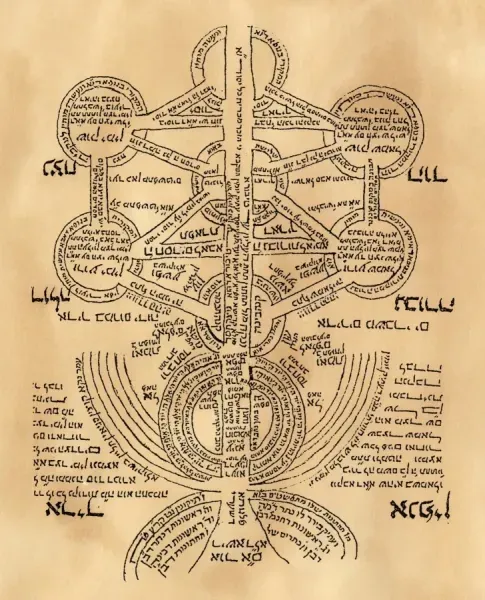
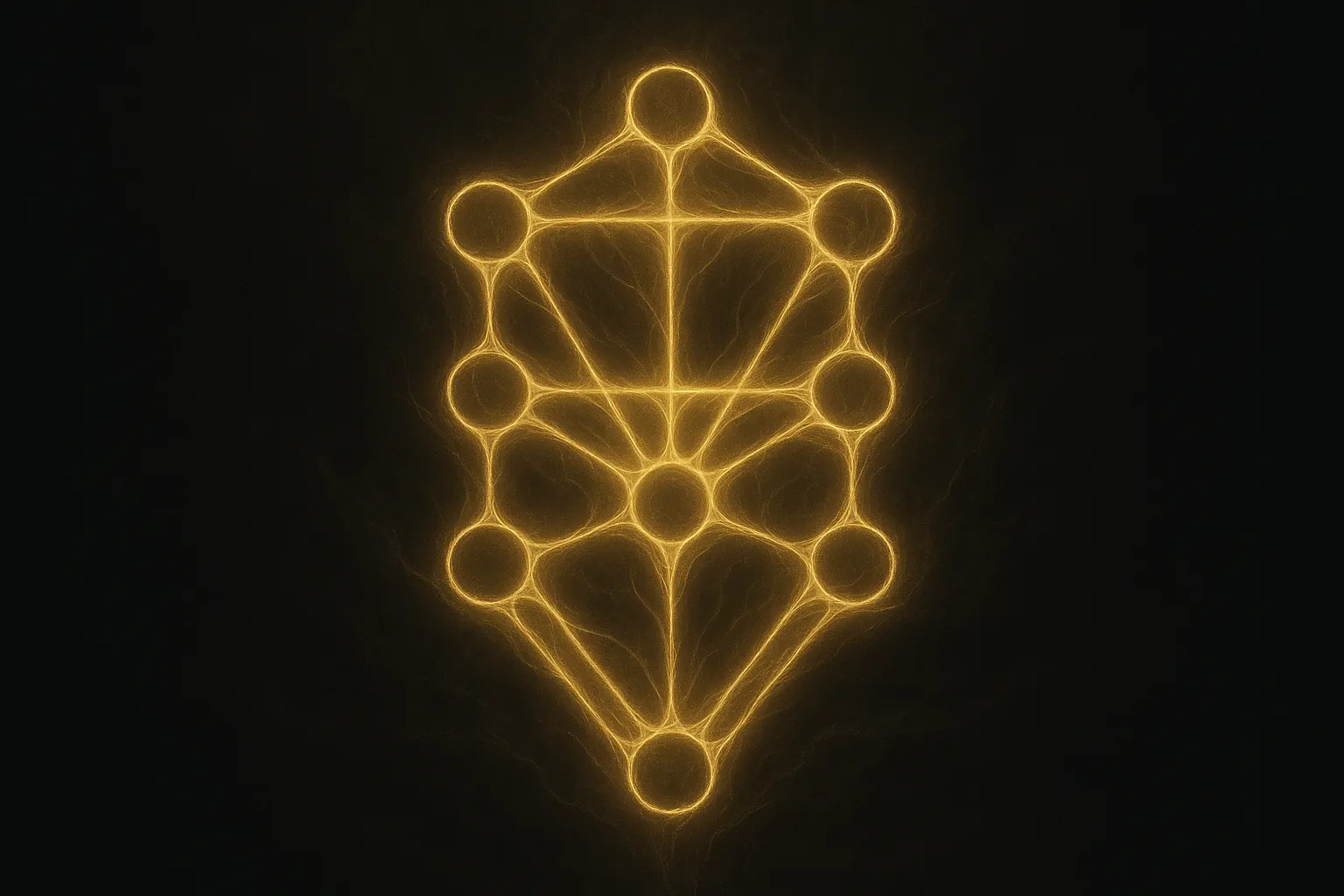
The Tree of Life is not a diagram to be memorised but a living organism through which the Divine expresses, descends, and returns. Its ten sephiroth are emanations of intelligence that pulse through every level of creation. Each is both a station of consciousness and a doorway through which the Infinite perceives itself.
From the limitless light of Ain Soph Aur emerges Kether, the Crown—pure intention at the edge of manifestation. The lightning path descends through Chokmah (Wisdom) and Binah (Understanding), through the moral sephiroth of Mercy and Severity, until it roots in Malkuth, the Kingdom: our embodied world. The return journey reverses the same currents as the soul, having touched matter, learns to raise it back toward light.
The Tree operates through Four Worlds, each a lens through which the same divine energy manifests:
- Atziluth (Fire) — the realm of divine will and archetypal vision, where intention exists before form.
- Briah (Water) — the world of creative intellect and emotional depth, where concepts receive their first shape.
- Yetzirah (Air) — the world of formation, where angels structure thought into pattern.
- Assiah (Earth) — the world of action and manifestation, where the divine dream becomes matter.
To contemplate the Tree is to sense where energy flows freely and where it has become obstructed. When we meditate upon the sephiroth, we are not studying symbols but engaging living intelligences that speak through intuition, synchronicity, and revelation.
Within Lucian Kabbalah, this living architecture carries the corrected planetary attributions of the Sefer Yetzirah—Saturn at Beth, Jupiter at Gimel, Mars at Daleth, and so on down to the Moon at Tav. The planets descend in geocentric order as you move down the Tree, a geocentric planetary descent model derived from the Sefer Yetzirah sequence. The Tree becomes not just a mirror of the soul but a precise instrument of spiritual diagnostics—a way to read what the heavens are declaring about your path of return.