The Seven Planetary Errors at the Heart of Western Esotericism
How the Golden Dawn Reassigned the Planets — and What the Sefer Yetzirah Actually Teaches
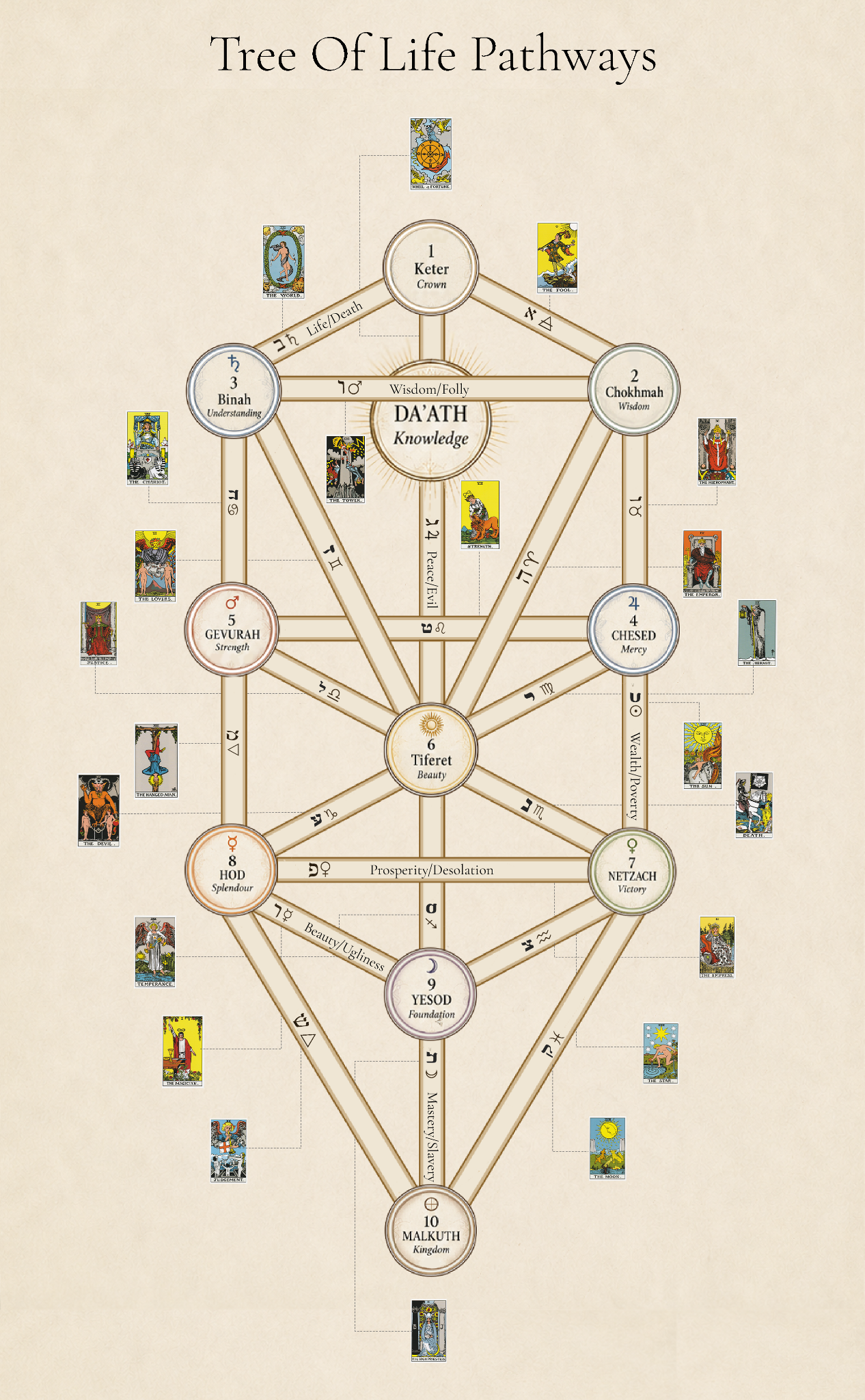
Frater Lucis · 12 February 2026

In 1781, a French Protestant pastor named Antoine Court de Gébelin walked into a Parisian salon and watched someone playing a card game with a Tarot deck. In that moment, he became convinced he was looking at fragments of ancient Egyptian wisdom — the scattered pages of the legendary Book of Thoth, preserved by accident in a deck of playing cards.
He was wrong. The Tarot originated in 15th-century Italy as a game called tarocchi. It had no Egyptian provenance. De Gébelin couldn't have known this because nobody could read Egyptian hieroglyphics — the Rosetta Stone wouldn't be discovered for another eighteen years. But his intuition was seductive: that these 22 images weren't entertainment but encoded sacred knowledge, hidden in plain sight for centuries.
That single, unfounded intuition became the seed of a long lineage of misalignment in Western esotericism as we know it today.
Lévi's Mapping
Seventy-five years later, in 1856, a defrocked French Catholic seminarian named Alphonse Louis Constant — writing under the pen name Éliphas Lévi — took de Gébelin's Egyptian fantasy and did something far more consequential. In his Dogme et Rituel de la Haute Magie, Lévi mapped the 22 Major Arcana of the Tarot onto the 22 letters of the Hebrew alphabet in simple sequential order. Aleph to the Magician. Beth to the High Priestess. Gimel to the Empress. And so on, straight through the alphabet.
This created the appearance of a Kabbalistic framework. Hebrew letters on the cards. Cards on the paths of the Tree of Life. Suddenly, the Tarot looked like it belonged to the Jewish mystical tradition.
But Lévi was not a Kabbalist. He was a Hermeticist building a unified system of Western ceremonial magic. He never consulted the Sefer Yetzirah — the foundational text of Jewish cosmological mysticism that actually describes how the Hebrew letters relate to planets, elements, and the zodiac. He didn't need to. His goal wasn't about staying true to the source material for Kabbalah. His goal was an elegant correspondence system, and the sequential mapping he created gave him one.
The problem is that the Sefer Yetzirah already provides its own mapping — and it doesn't match Lévi's.
What the Source Text Actually Says
The Sefer Yetzirah divides the 22 Hebrew letters into three groups: three "mother" letters (Aleph, Mem, Shin) corresponding to the elements Air, Water, and Fire; twelve "simple" letters corresponding to the twelve signs of the zodiac; and seven "double" letters corresponding to the seven classical planets.
The seven double letters — Beth, Gimel, Daleth, Kaph, Pe, Resh, and Tav — are assigned to the planets in the classical geocentric order known to every ancient astronomer: Saturn, Jupiter, Mars, Sun, Venus, Mercury, Moon. This ordering runs from the slowest-moving visible planet to the fastest, reflecting the Chaldean understanding of the celestial spheres. It is consistent across the earliest manuscript traditions. Peter Hayman's critical edition, drawing on more than nineteen manuscript versions, confirms the agreement. Aryeh Kaplan's authoritative 1990 translation concurs. The Long Version says it. The Saadia Version says it. When planets are specified in connection with Hebrew double letters, they follow this order without exception in the early texts.
Beth is Saturn. Gimel is Jupiter. Daleth is Mars. Kaph is the Sun. Pe is Venus. Resh is Mercury. Tav is the Moon.
You can see the full chart on this page
What the Golden Dawn Did Instead
When MacGregor Mathers and the founders of the Golden Dawn adopted Lévi's system in the 1880s, they inherited his sequential letter-to-trump mapping — and with it, an immediate problem. Several Tarot cards carried obvious astrological symbolism that conflicted with the Hebrew letters they'd been assigned. The Magician, with its Hermetic associations, had been given Beth. But Beth in the Sefer Yetzirah corresponds to Saturn, not the Mercury that the Magician's imagery suggested. The High Priestess, with the Moon at her feet, had been given Gimel. But Gimel in the Sefer Yetzirah corresponds to Jupiter.
Faced with a choice between changing the card order or changing the source text, Mathers chose to change the source text.
He reassigned all seven planetary attributions, claiming to have discovered "the true order" and asserting that the planetary correspondences in the Sefer Yetzirah were "most blinded" — meaning deliberately obscured. The rationalisation was that the Jews had either corrupted or intentionally concealed the correct attributions in their own sacred text, and that the Golden Dawn had recovered the truth.
The result was a complete inversion. Every single one of the seven double-letter planetary attributions was changed. Not one remained in its original position. Beth became Mercury instead of Saturn. Gimel became the Moon instead of Jupiter. Daleth became Venus instead of Mars. Kaph became Jupiter instead of the Sun. Pe became Mars instead of Venus. Resh became the Sun instead of Mercury. Tav became Saturn instead of the Moon.
The Chaldean geocentric order — the oldest astronomical framework in Western civilisation — was replaced wholesale by an arrangement that served the needs of the Tarot's existing imagery.
The Chain of Inheritance
What happened next is a study in uncritical transmission. Arthur Edward Waite commissioned the Rider-Waite-Smith deck in 1909, the most widely used Tarot deck in the world, designed entirely within the Golden Dawn's framework. Aleister Crowley modified some attributions for his Thoth deck but kept Lévi's fundamental letter-to-trump mapping. Paul Foster Case founded BOTA on Golden Dawn correspondences. In 1935 Dion Fortune wrote The Mystical Qabalah using the same Tree. 1937 Israel Regardie published the Golden Dawn's complete rituals and correspondences, making Mathers' reassigned attributions publicly available for the first time. Robert Wang produced The Qabalistic Tarot, widely considered the definitive path-by-path analysis, with every reading built on the reassigned planets.
By the mid-20th century, every major Tarot-Kabbalah book in the English-speaking world carried the Golden Dawn's attributions. The error had become invisible — not because it was hidden, but because it was everywhere. It became the water that Western esotericism swims in - even today. Modern authors didn't cite the Golden Dawn's planetary attributions as one interpretation among others. They presented them as the Kabbalistic correspondences, as though the Sefer Yetzirah itself had assigned them. It hadn't. It had assigned the opposite.
What Was Lost
It is important to be precise about the scale of this. Fifteen of the twenty-two paths are unaffected. The three mother letters and their elemental attributions are the same in both systems. Ten of the twelve simple letters and their zodiacal attributions align. The Tree of Life structure itself is unchanged. The sephiroth are intact. The overall architecture stands.
But seven paths — every path governed by a planet — carry the wrong celestial attribution. And because planetary energies colour everything about how a path is interpreted, read, meditated upon, and taught, those seven misattributions ripple outward through every pathworking, every tarot reading, every meditation, and every teaching that depends on them.
The middle pillar of the Tree, for instance — the vertical axis from Malkuth to Kether that represents the soul's ascent — runs through three of these affected paths. Under the Golden Dawn system, it begins with Saturn at the base and ends with the Moon at the crown. Under the Sefer Yetzirah's actual attributions, it begins with the Moon and ends with Jupiter. One version starts with cosmic finality and ends with veiled mystery. The other begins with turning inward and ends with the expansive grace of God. One is a ceiling. The other is an opening.
What This Means
This is not a call to discard the Western esoteric tradition or to dismiss the sincere practitioners who have built meaningful spiritual lives within it. The Golden Dawn's system is internally coherent. It has helped people for over a century. Practitioners like John Michael Greer, Dion Fortune, and Benebell Wen have done rigorous, generous work within its framework.
But it is an entirely different framework from what it claims to be. Calling it Kabbalah doesn't make it Kabbalah, any more than serving chicken on a bun instead of beef makes something a hamburger. The Western Hermetic tradition built something real — but what it built departed from its claimed source text at the most verifiable point imaginable: which planet goes with which letter.
The Sefer Yetzirah is not an obscure document. It has been in continuous circulation for over a thousand years. Its planetary attributions are not ambiguous. They follow the oldest astronomical ordering system in Western history. And for 170 years, very few in the dominant Western esoteric tradition checked.
The cards still map to the letters. The letters still map to the paths. The paths still connect the sephiroth. Nothing is destroyed by this correction. But seven paths are restored to the cosmological positions their source text actually describes — and when they are, the Tree begins to teach lessons it hasn't been able to teach since 1856.
The question is not whether the Sefer Yetzirah says something different from the Golden Dawn. It demonstrably does. The question is whether we're willing to let the source text speak for itself.